
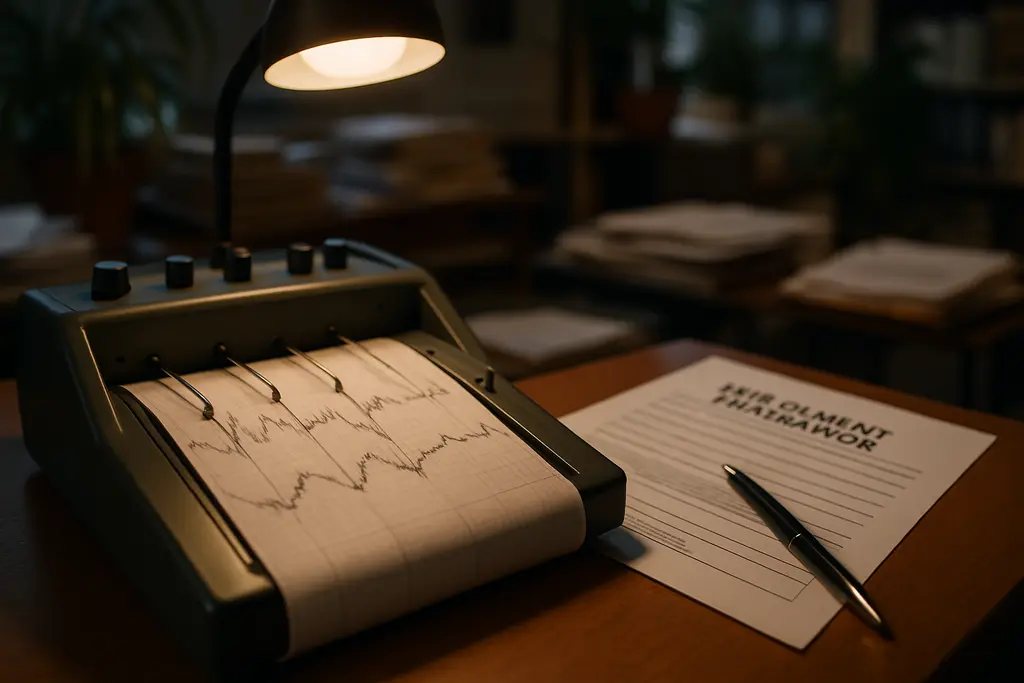
An innocent person undergoes a polygraph examination during a criminal investigation. The examiner evaluates the results, but the suspect is told the test shows deception. Under pressure to explain an apparently incriminating finding, the person eventually confesses to a crime they did not commit.
This is not simply a theoretical concern. A 2026 peer-reviewed study of polygraph use in false-confession cases examined 56 cases involving people who falsely confessed and were later exonerated. The researchers found troubling differences between documented polygraph outcomes and what suspects were told about their results.
Of the 36 cases where an examiner’s decision could be established, only eight had outcomes the researchers classified as accurate. The study also found that suspects were almost invariably told their examinations indicated deception, including cases in which the documented outcome was inconclusive or favorable.
The findings expose an important distinction in polygraph testing: the physiological measurements, the examiner’s interpretation and the message delivered to the examinee are three different things.
Understanding that difference is essential for evaluating the risks of polygraph-assisted interrogation, especially when an examination is followed by a confession.
What the 2026 Exoneration Study Actually Found
The study, published in Legal and Criminological Psychology on March 8, 2026, was conducted by Ben Denkinger, Jeremy Harper, Henry Yoon and William Iacono.
The researchers examined cases documented by the National Registry of Exonerations, using publicly available case records and supporting materials to investigate how polygraph examinations were used during interrogations.
Their final sample contained 56 cases in which an innocent person underwent a polygraph examination, falsely confessed and was subsequently exonerated.
The researchers investigated several aspects of the examination process, including the documented result, what the suspect was told, the evidence available before testing and factors that could increase vulnerability to false confession.
Three findings deserve particular attention.
First, a substantial proportion of the available examiner judgments did not correctly identify the examinees as truthful.
Second, the information communicated to suspects frequently presented the examination as evidence of deception, even where the underlying documented outcome did not justify that characterization.
Third, the researchers found that examinations were often administered to people without strong independent evidence already implicating them in the offence.
The authors described a pattern in which polygraph testing could become part of a broader effort to persuade suspects that their own physiological responses demonstrated guilt.
They referred to this practice as the Polygraph Self-Incrimination Ploy.
That terminology describes an interrogation concern, not a separate physiological measurement or validated polygraph technique.
Why the findings should not be presented as a general accuracy rate
The study’s 56 cases were selected from a specific group: people who falsely confessed and were later exonerated.
They were not randomly selected from everyone who underwent a criminal-investigation polygraph.
This distinction prevents the findings from supporting a general claim that polygraphs produce inaccurate conclusions in a particular percentage of all examinations.
The researchers had documented examiner judgments for 36 cases, leaving 20 without that information.
The eight accurate judgments among those 36 cases describe the outcomes available within this selected group. They cannot be used to estimate the overall accuracy of polygraph testing across police investigations, employment screening or other settings.
Similarly, the research identifies a concerning pattern involving polygraphs and false confessions. Its retrospective design cannot establish that the polygraph procedure independently caused every confession.
Those limitations do not make the findings unimportant.
They define what the evidence can establish: real cases existed in which people later proven innocent were confronted with polygraph-related accusations during interrogations that resulted in false confessions.
A Polygraph Examination Produces More Than One Kind of Record
A major lesson from the study is the need to distinguish the different stages of a polygraph-assisted investigation.
The physiological recording
A conventional polygraph measures bodily responses during structured questioning.
These may include changes in respiration, cardiovascular activity and electrodermal activity.
The instrument records physiological information. It does not directly observe whether a person committed an offence or intentionally provided a false answer.
Responses can be affected by several influences, including the person’s psychological state and the significance of the questions.
The examiner’s assessment
An examiner evaluates the physiological information using the selected examination method.
Depending on that method and the quality of the data, the assessment may support a conclusion indicating deception, a conclusion indicating no deception, or an inconclusive outcome.
Those classifications represent an interpretation of the recorded information.
They are not interchangeable with independently established facts about the alleged offence.
The possibility of professional disagreement is examined in Polygraphianz’s article on independent polygraph chart review, which describes documented cases where a second assessment changed an initially definite result to no opinion.
The result communicated during the interview
After a polygraph examination, investigators may discuss the result with the examinee and ask additional questions.
The description given to the person becomes a separate and consequential part of the investigative process.
A result that was actually inconclusive might be described as a failure. An unfavorable interpretation may be presented with greater confidence than the evidence supports.
In some circumstances, a suspect may be encouraged to treat the examiner’s statement as proof that denying involvement is futile.
This is where the 2026 findings become particularly important.
The problem is not confined to whether the original scoring was correct.
It also concerns whether the information used to influence the suspect accurately reflected the examination.
Why a Reported Polygraph Failure Can Increase Interrogation Pressure
A person accused of serious wrongdoing may already be experiencing substantial stress.
An unfavorable polygraph announcement can introduce another source of pressure, particularly if the person believes the instrument has scientifically established their guilt.
That belief may be stronger when the examiner presents the outcome as conclusive.
Imagine a hypothetical suspect who knows they did not commit the alleged offence but is told their physiological responses demonstrate deception.
The person may begin questioning the reliability of their own explanation, especially if investigators repeatedly challenge their denials.
An investigator might also suggest that providing an admission would be more productive than continuing to dispute the examination.
The example does not mean every person receiving unfavorable polygraph feedback will confess falsely.
Rather, it illustrates how a technical assessment can acquire persuasive authority during an interview.
The risk is particularly concerning when other pressures are present.
Research on false confessions has identified vulnerabilities associated with factors such as youth, difficulties understanding interrogation procedures and certain psychological or cognitive characteristics.
The 2026 exoneration study found that some people in its sample possessed vulnerabilities previously associated with false confessions.
These characteristics do not establish that a person will confess falsely.
They are reasons for investigators to exercise additional care when evaluating the voluntariness and reliability of statements.
A Confession Does Not Automatically Validate the Polygraph
One of the most persistent misunderstandings about polygraph-assisted investigations concerns the relationship between an examination and a subsequent confession.
An investigator might reason that if a suspect was told they failed a polygraph and later confessed, the examination must have identified deception accurately.
That conclusion does not necessarily follow.
A person can make a truthful admission during questioning even when the preceding physiological assessment was inconclusive or inaccurate.
An innocent person can also provide a false confession after being confronted with seemingly persuasive but incorrect information.
The confession itself therefore cannot automatically establish that the instrument worked.
This distinction was addressed more than two decades before the recent exoneration study.
In its 2003 report The Polygraph and Lie Detection, the National Research Council distinguished the accuracy of physiological deception detection from the investigative usefulness of the examination process.
The council’s assessment of polygraph validity and admissions explained that confessions or admissions obtained during polygraph examinations do not automatically provide evidence that the physiological method accurately detected deception.
The researchers identified a critical circular-reasoning problem.
If an examiner interprets a physiological response as evidence of deception, confronts the person with that interpretation and obtains an admission, the admission cannot necessarily serve as independent confirmation of the original assessment.
The validity of the admission must be established separately.
That principle remains relevant to modern examinations, including those using automated scoring.
A computer-generated assessment does not become independently validated merely because a person later changes their account.
What Independent Evidence Can Establish
The central investigative challenge is determining whether a statement accurately describes what happened.
A confession may contain details that can be compared with evidence collected independently of the interview.
Depending on the case, that evidence might include communications, financial records, forensic findings, witness accounts or other verifiable information.
However, investigators must also consider whether the person learned important details from questioning, case materials or public reporting.
A statement containing accurate information is less persuasive as independent corroboration if the information was supplied to the speaker during the interrogation.
This is why preserving the sequence of events matters.
Investigators should be able to establish what evidence existed before the polygraph, what information was communicated during the examination and what the person disclosed afterward.
Without that chronology, it may be difficult to distinguish genuinely new investigative information from statements influenced by the questioning process.
The aim is not to assume that every confession is unreliable.
It is to evaluate whether the available evidence supports the confession independently of the pressure or claims that preceded it.
The Difference Between a Screening Result and an Interrogation Tactic
A polygraph may be used for different purposes.
Some examinations are intended to evaluate responses concerning a specific incident.
Others are used in screening or security-related processes, subject to the applicable laws and organisational requirements.
A criminal interrogation adds another dimension: investigators may use statements about the examination to influence the person’s willingness to continue denying involvement.
These uses should not be evaluated as though they were identical.
A physiological assessment and an interrogation strategy can produce different consequences even when they occur during the same session.
This is also why the 2026 exoneration research should not be directly applied as an accuracy study of routine workplace testing.
The study concerned criminal suspects in the United States who falsely confessed and were eventually exonerated.
It did not measure the performance of Australian or New Zealand workplace polygraph programmes.
Nevertheless, its findings raise a broader professional question relevant to anyone administering or commissioning a credibility assessment:
Can the person being examined distinguish what the instrument recorded, what the examiner concluded and what investigators are claiming the result establishes?
When those distinctions are blurred, the examination can acquire an authority beyond what the underlying evidence supports.
Five Safeguards Against Misleading Polygraph Feedback
The findings suggest several practical safeguards for investigators and examination providers operating in settings where testing is lawful.
- Preserve the original examination records. Retain the physiological charts, relevant questions, scoring documentation and any quality-control findings in accordance with applicable rules.
- Describe outcomes accurately. An inconclusive result should not be represented as a demonstrated failure. Professional uncertainty should remain visible in the record.
- Document post-test questioning. Where lawful and appropriate, an accurate recording or equivalent documentation should preserve what the examinee was told and what they actually said in response.
- Evaluate vulnerabilities and procedural fairness. Investigators should consider comprehension, age, communication needs and other factors that may affect how a person responds to questioning.
- Seek independent corroboration. Important admissions and alleged facts should be checked against evidence obtained independently, rather than being treated as proof that the examination was correct.
These considerations do not guarantee that false confessions will be prevented.
They address identifiable weaknesses in the process and make subsequent evaluation more transparent.
A properly preserved record also makes it easier for independent reviewers to determine whether the communicated result matched the documented examination.
Implications for Polygraph Services in Australia and New Zealand
The 2026 findings come from American criminal investigations, and their legal implications cannot automatically be transferred to Australia or New Zealand.
The rules governing police interviews, admissibility of evidence, privacy and employment investigations differ by jurisdiction.
Private-sector polygraph providers should not assume that an interrogation technique permitted in one legal system is appropriate or lawful in another.
For organisations considering polygraph services, the practical relevance lies in professional communication and evidence handling.
An examiner should distinguish between the instrument’s measurements, the interpretation produced under the chosen testing method and any subsequent information disclosed by the examinee.
A client organisation should also understand whether a reported admission occurred before testing, during the examination or after the result was discussed.
That timing matters.
An employer reviewing an investigation should be cautious about describing a post-test statement as evidence that a polygraph accurately identified dishonesty unless the underlying facts have been independently established.
The same principle applies to technology that generates automated credibility scores.
A software-generated recommendation should not be presented as conclusive proof of misconduct merely because the system appears technically sophisticated.
Professional credibility depends partly on acknowledging what the procedure cannot establish.
The Real Lesson of the 56 Exonerations
The 2026 study does not prove that every polygraph examination creates a risk of false confession or that every unfavorable result is incorrect.
It documents a narrower but serious problem.
In a selected group of exoneration cases, polygraph examinations were used during interrogations that ended in false confessions. The researchers also documented substantial concerns about examiner outcomes, the information communicated to suspects and the circumstances in which the examinations occurred.
The most useful lesson is that the process must be evaluated beyond the physiological charts.
An examiner’s conclusion, the language used to communicate it and the statements obtained afterward each require separate scrutiny.
A confession may provide important investigative information. But its reliability depends on the evidence and circumstances supporting it, not simply on the fact that it followed a lie-detector examination.
The recorded polygraph result and the story told about that result must never be treated as the same evidence.
When a person’s liberty, reputation or career is at stake, preserving that distinction is fundamental to fair and defensible investigation.