
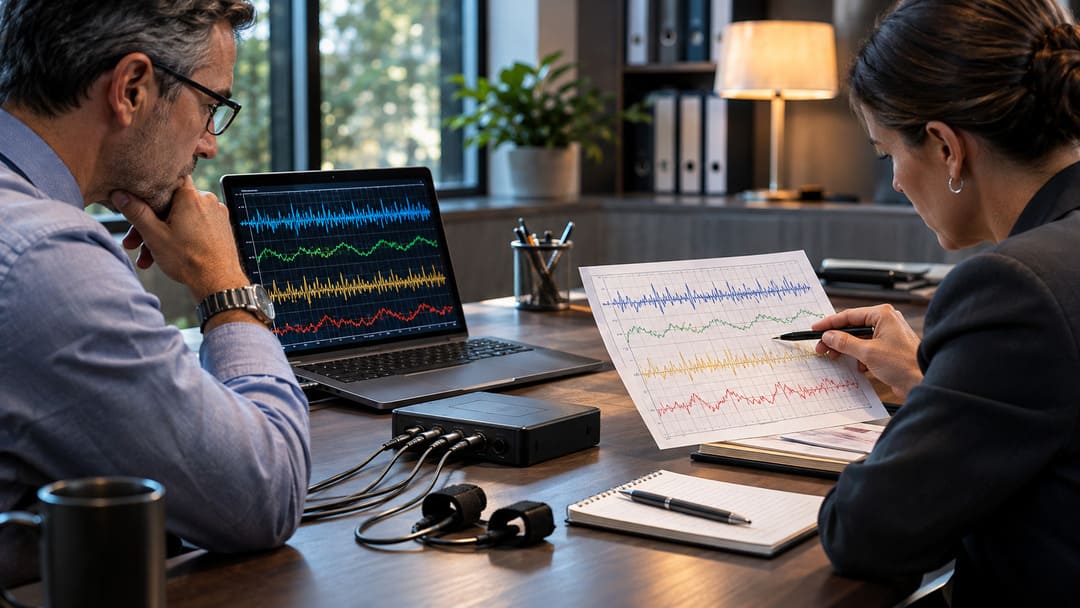
A polygraph examiner reports that someone’s physiological responses indicate deception. A second qualified examiner studies the same examination records but reaches a different conclusion: the available data do not support a definite opinion.
Neither examiner collected a new set of measurements. The difference emerged from reviewing the existing evidence.
This is not merely a hypothetical problem. Federal government investigations have documented occasions when independent polygraph scoring changed an apparently conclusive assessment into an inconclusive one.
The distinction matters because polygraph independent review is designed to evaluate the quality and interpretation of an examination, not simply confirm the original examiner’s judgment.
For employers, investigators and people undergoing testing, these cases reveal a limitation that often receives less attention than general accuracy claims: the same recorded physiological information can sometimes support different professional assessments.
Understanding why that happens is essential before treating a polygraph report as reliable evidence.
What a Polygraph Independent Review Actually Examines
A conventional polygraph records physiological responses while an examiner asks structured questions.
Depending on the equipment and examination method, the recorded measurements generally include breathing patterns, cardiovascular activity and changes in skin conductance.
The examiner interprets these measurements according to a testing format and scoring procedure.
That process involves several decisions. The examiner must determine which physiological responses are suitable for evaluation, apply the selected scoring rules and decide whether the recorded information meets the method’s decision criteria.
Independent quality control introduces another qualified professional into the assessment.
The reviewer may examine the original physiological charts, question construction, recorded observations and other examination documentation.
The purpose is not simply to look for mathematical mistakes.
A review can identify disagreements about the strength of physiological responses, the quality of the recordings or whether the examination followed the relevant procedures.
Importantly, reviewing a report is not necessarily equivalent to independently evaluating the underlying test data.
An organisation that receives only a brief summary may be unable to determine whether the examination was conducted properly or whether the recorded measurements support the reported conclusion.
The ability to examine the original evidence is what gives an independent review its potential value.
A Federal Investigation Shows How Three Findings Changed
One of the clearest documented examples comes from a United States Secret Service investigation following allegations of employee misconduct during preparations for the 2012 Summit of the Americas in Cartagena, Colombia.
The investigation included interviews, examination of communications and other records, and polygraph testing.
In its January 2013 review, the Department of Homeland Security Office of Inspector General examined the agency’s investigative response, including the procedures used for polygraph examinations.
The official inspector general report on the Secret Service investigation records an important disagreement between the agency’s original assessments and an independent evaluation.
The Secret Service administered 14 polygraph examinations to ten employees, involving 22 examination series.
The National Center for Credibility Assessment (NCCA), which provides federal polygraph training and oversight, independently assessed the examination material.
It agreed with the original conclusions in 19 of the 22 series.
In the remaining three, however, the reviewers could not support the definite conclusions reached by the original examiners.
Two series had initially received findings of no deception indicated. The other had received a finding of deception indicated.
The independent assessment classified all three as no opinion.
That detail is particularly significant.
The independent reviewers did not simply change an unfavorable finding into a favorable one, or vice versa. They concluded that the recorded information did not justify a definitive assessment.
Why the reviewers reached different conclusions
The inspector general’s report explained that two disagreements resulted from differences in scoring methods and interpretation of the physiological information.
NCCA determined that the original scoring method complied with federal polygraph standards, despite the differences between the assessments.
The third disagreement involved physiological data that were too poor to assign a reliable score.
These distinctions are useful because they reveal two different sources of uncertainty.
One concerns interpretation: qualified professionals may evaluate physiological information differently while using methods permitted by the relevant standards.
The other concerns data quality: a recording may not provide sufficient usable information for a conclusion.
The 2013 findings do not establish that the original examiners deliberately misrepresented their results. Nor do they establish that the employees were truthful or deceptive.
They demonstrate that independent review can expose uncertainty hidden behind a definitive classification.
The 19 agreements and three disagreements also should not be converted into a general polygraph accuracy statistic. They concerned examination series from one investigation, not a representative validation study.
Another Federal Audit Found a Problem With Reviewer Independence
Independent review is valuable only when the reviewer can reach a judgment without inappropriate influence from the original assessment.
A later federal audit identified weaknesses in precisely that safeguard.
In July 2018, the Department of Homeland Security Office of Inspector General published a review of U.S. Customs and Border Protection’s polygraph programme.
The agency used polygraph examinations in screening applicants for law-enforcement positions.
Under CBP’s quality-control procedures at the time, an examination was not considered final until quality-control personnel reviewed and certified the result.
However, the 2018 inspector general audit of CBP’s polygraph programme found that the process did not always operate as intended.
Auditors examined a statistical sample of 380 examinations conducted during fiscal years 2013 through 2016.
Although the programme’s records indicated that quality-control requirements had been satisfied, reviewers could communicate with one another or with the original examiner before finishing their assessments.
That created a risk that the supposedly independent judgment could be influenced by another examiner’s opinion.
The audit did not establish that those communications changed the outcome of a particular examination.
Its finding was procedural: the review system did not always provide the intended protection against influence.
CBP revised its quality-control procedures in September 2017, during the audit process, to require independent and objective reviews.
The distinction between blind and objective review also appeared in the agency’s response.
CBP described objective review as the preferred terminology and introduced clearer restrictions on communication before a second reviewer completed an assessment.
This was not simply a matter of renaming the procedure.
The underlying safeguard was that an independent professional should be able to reach a reasoned judgment before being exposed to potentially influential opinions from colleagues.
Agreement Between Examiners Is Not the Same as Scientific Accuracy
Independent review raises another distinction that matters beyond polygraph testing.
In measurement science, reliability concerns whether a procedure produces consistent results.
Validity concerns whether the procedure measures or establishes what it claims to measure.
Two examiners might independently interpret the same physiological recordings in the same way.
That agreement provides information about the consistency of their assessments.
It does not automatically prove that their conclusion accurately identifies deception.
The National Research Council examined this problem in its 2003 report, The Polygraph and Lie Detection.
The report recognised the value of detailed quality-control procedures while warning that improved consistency does not necessarily establish greater accuracy.
A scoring procedure might produce strong agreement because every examiner follows the same rules.
But if those rules systematically produce an incorrect interpretation, consistent application will not eliminate the underlying error.
Conversely, a disagreement between reviewers does not necessarily mean that the examination was conducted incompetently.
It may reveal genuine uncertainty within the scoring procedure or limitations in the recorded information.
This creates a practical distinction between two questions:
Was the examination conducted and interpreted consistently with the applicable procedures?
Does the resulting interpretation reliably establish the alleged deception?
Quality control can help answer the first question.
The second requires scientific validation and consideration of the circumstances in which the test is used.
The polygraph instrument records physiological activity rather than dishonesty itself. Different psychological and physiological conditions can influence the responses being measured.
No amount of reviewer agreement removes that fundamental limitation.
What a Meaningful Independent Review Should Include
Not every second opinion offers the same level of scrutiny.
An examiner who reads another professional’s final report and agrees with its conclusion has performed a different task from someone who independently scores the original physiological data.
A stronger quality-control process should address four areas.
- Access to the original examination material. Reviewers need sufficient records to examine the physiological data, relevant questions and analytical methods. A summary conclusion alone is inadequate for a technical reassessment.
- Independence before the initial review. The process should reduce inappropriate influence from the original examiner’s conclusions or other reviewers’ judgments. Necessary information about the test format should still be available.
- Examination quality and suitability. Reviewers should determine whether the recorded information is sufficiently clear and complete to support analysis and whether the examination followed the applicable procedures.
- Documentation of disagreements. When reviewers reach different conclusions, the record should identify the disputed issue and how the matter was handled, rather than silently replacing one finding with another.
These are practical quality-control considerations, not a claim that every jurisdiction or private examination provider is legally required to use the same procedure.
Professional standards and agency rules differ.
Polygraphianz’s earlier examination of how APA standards strengthen polygraph integrity provides related background on recordkeeping, consent, examiner responsibilities and the role of professional review.
The distinctive concern in independent chart evaluation is whether another qualified examiner can assess the underlying measurements without simply reproducing the original conclusion.
A “No Opinion” Result Is Not Evidence of Innocence or Guilt
The Secret Service case demonstrates why terminology matters.
A finding of deception indicated generally represents an examiner’s interpretation that the recorded responses meet the relevant criteria for that classification.
A finding of no deception indicated represents a different interpretation under the applicable method.
A no opinion classification means the examiner cannot render a conclusive judgment from the physiological evidence.
It does not establish that the person lied.
It also does not prove that the person was truthful.
The result may arise from insufficient data quality, ambiguous responses or a scoring outcome that does not support a definite classification.
The precise terminology and procedures vary by testing format and organisation.
This matters when examination results influence investigations or employment decisions.
Someone receiving an inconclusive assessment should not automatically be described as having failed a polygraph.
Likewise, an inconclusive outcome should not automatically be presented as confirmation of the person’s account.
Where another examination is considered, the organisation should assess whether repeating the procedure is appropriate, lawful and likely to produce useful additional information.
A repeat examination is not inherently a better answer to an unresolved result.
Sometimes the more productive next step is to examine independent evidence rather than collect another set of physiological recordings.

What Employers and Examinees Can Learn From These Cases
The two federal audits provide lessons that extend beyond government security screening, although their particular rules should not be assumed to govern private testing in Australia or New Zealand.
For employers, the first lesson is to understand the difference between an examination report and an independently reviewed examination.
A report may carry professional credentials and formal language while still containing an interpretation that another qualified reviewer would classify differently.
That does not make every report unreliable.
It means important decisions should not depend solely on an unexplained outcome.
Organisations considering legally permissible polygraph testing should establish the applicable standards, the available review process and how disagreements will be resolved before relying on results.
For examinees, the key lesson is that professional conclusions can contain uncertainty.
Someone questioning an assessment may reasonably want to understand which procedure was used, whether the examination received quality-control review and what opportunities for clarification exist.
Access to records, independent review and retesting may depend on the provider, contract, agency policy and applicable privacy or employment law. There is no universal entitlement to a particular review process.
The scientific limitations also remain relevant to every party.
An independent assessment cannot prove that a polygraph is universally accurate, and an unfavorable result does not independently establish misconduct.
The ultimate value of the examination depends on the quality of the procedure, the validity of the underlying method and its relationship to other evidence.
A Second Opinion Can Make a Result Less Certain—and More Defensible
The most revealing aspect of the 2013 Secret Service review is that the independent assessment did not replace three conclusions with equally confident opposing findings.
It replaced them with uncertainty.
The 2018 CBP audit adds a procedural lesson: independent review must be structured so that reviewers can assess evidence without inappropriate influence.
Together, the cases show why quality control is not simply an administrative step performed after testing.
It can change how decision-makers should understand the evidence.
A properly documented disagreement may be inconvenient for an organisation seeking a straightforward answer. Yet acknowledging uncertainty can be more defensible than preserving a definitive conclusion that the available information does not support.
The purpose of independent polygraph review should not be to guarantee agreement. It should be to establish how much confidence the examination actually deserves.
When careers, reputations or investigative decisions are at stake, that distinction matters far more than the appearance of certainty.