
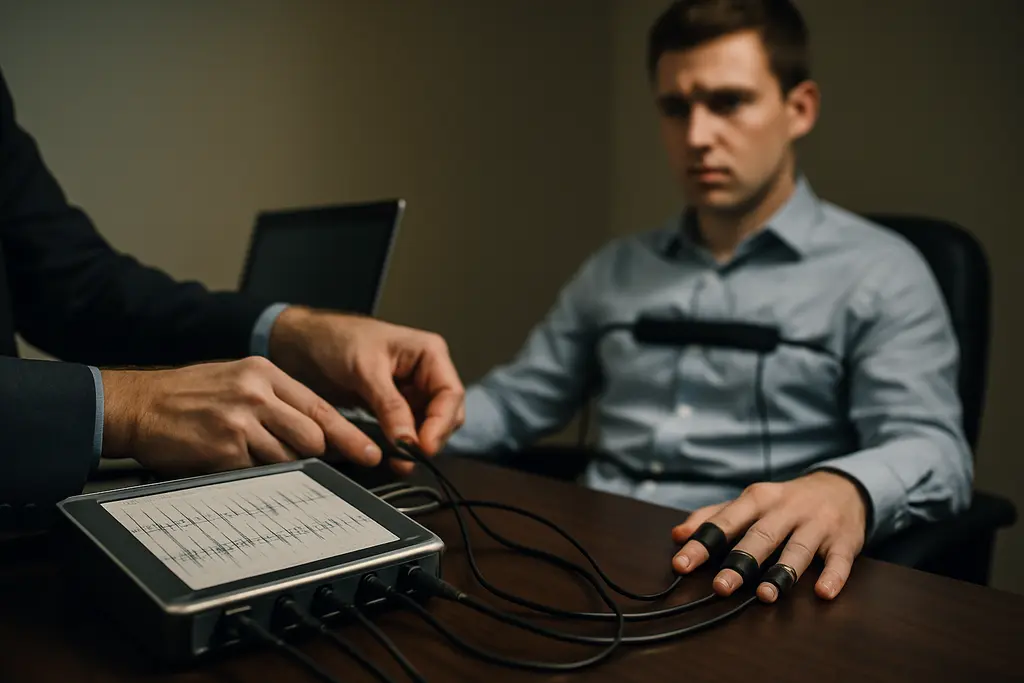
Polygraph Testing Limits deserve careful attention in security contexts because the stakes are rarely confined to a single interview. A screening decision can affect a worker’s reputation, a clearance process, an internal investigation, or an agency’s ability to assess risk. The useful starting point is not whether a polygraph can provide information; it can. The more precise question is how much weight that information should receive when the broader record may be incomplete, disputed, or affected by administrative data problems.
A polygraph records physiological responses and places those responses within an interview structure. In security settings, that process may sit beside background investigations, personnel files, self-disclosures, adjudicative review, and internal policy controls. Treating any one input as decisive can create a false sense of certainty. The better practice is to ask what the test is designed to measure, what it cannot show, and how the result will be checked against independent evidence.
Why Polygraph Testing Limits Matter in Security Screening
Polygraph Testing Limits and Screening Base Rates
Polygraph Testing Limits become more visible in screening programs than in narrowly defined incident testing. Security screening often tries to identify rare conduct across a large population. When the underlying rate of the targeted conduct is very low, even a tool that performs better than chance can produce serious decision problems. False positives may place innocent people under suspicion, while false negatives may leave actual risk undetected.
The research record distinguishes between a specific-incident exam and a screening exam. A specific-incident exam asks about an identified event. A screening exam may ask broader questions about undisclosed activity or potential security concerns. That difference matters because broad screening depends on assumptions about rare events, population risk, and the ability of the process to separate truthful from deceptive responses under varied conditions.
Specific-Incident Testing Is a Different Question
Security teams sometimes compress several questions into one phrase: does the polygraph work? That wording is too broad. A better question is whether the chosen format is suitable for the decision at hand. A narrowly framed investigation, supported by documents, access logs, witness accounts, or other evidence, is different from a periodic screening program used across a workforce.
That distinction should shape policy. If an organization uses testing in a workplace integrity program, the result should be evaluated as one signal, not as a direct reading of truth. Readers who want a process-level explanation of what happens before, during, and after an exam may find this related discussion of polygraph testing science and limits useful.
What Recent GAO Reviews Say About Oversight
FY 2024 Data Reliability Problems
Security decisions depend not only on interview methods but also on the quality of the systems used to track and oversee those decisions. A recent GAO review of FY 2024 security clearance data found that more than 60 percent of key statistics used for oversight across eight reporting requirements were inaccurate or incomplete. The same review reported that 118 of 305 descriptive statistics were inaccurate and 73 were incomplete; among the inaccurate figures, 60 had an error of 50 percent or more, and 34 had an error of 100 percent or more, according to the GAO security clearance data review.
That finding does not prove anything about a particular polygraph examination. It does show why oversight quality matters. If a security program cannot rely on key reporting statistics, managers may have difficulty evaluating timeliness, consistency, workload, outcomes, or risk signals. In that setting, Polygraph Testing Limits are not only scientific or procedural. They also relate to governance: how results are recorded, who reviews them, and whether the surrounding data can support sound conclusions.
Trusted Workforce 2.0 Signals a Wider Vetting Shift
On May 9, 2025, GAO reported observations on the federal Trusted Workforce 2.0 personnel vetting reform initiative. Its contractor survey found that about 40 percent of contractors reported some improvement in the efficiency of requesting security clearances, and about 45 percent reported faster preliminary determinations. The same GAO work also identified continuing challenges involving IT compatibility and delays in background investigations, as described in the Trusted Workforce 2.0 review.
Those findings help place polygraph use in a broader setting. Vetting systems are not only about one interview or one test. They involve information systems, policy rules, investigation capacity, and adjudicative judgment. A polygraph program that is not integrated with those controls can appear more precise than it is. A program that acknowledges uncertainty, documents decision points, and keeps results in context is easier to review and less likely to overstate what the test can support.
Practical Use in Workplace Integrity Programs

Use Results as One Input
For employers and security offices, the central practical safeguard is proportionality. A polygraph result may justify further review, a follow-up interview, or comparison with other records. It should not automatically substitute for corroborating evidence. This is especially true where the consequences include restricted duties, delayed clearance action, reputational harm, or referral into a more formal inquiry.
A careful process should define the purpose of the exam before it begins. Is the goal to clarify a specific incident, assess a declared concern, or support a wider screening program? The answer affects question design, examiner preparation, consent procedures, record handling, and post-test review. It also affects how leaders explain the result to the person tested and to any decision-maker who later reads the file.
Explain the Process Before Testing
Transparency is not a courtesy add-on; it is part of a defensible process. People should understand the general phases of the examination, the kinds of sensors used, the role of the pre-test interview, and the limits of interpretation. They should also understand that physiological responses can be influenced by factors other than deception. Clear explanations reduce confusion and help prevent a test result from being treated as stronger than the process supports.
Security and workplace integrity teams can also benefit from comparing practices across related professional resources. For readers seeking adjacent integrity and organizational accountability material, Wakefield Rep offers a useful site within the same network.
- Define the purpose of the exam before scheduling it.
- Keep polygraph results separate from unsupported assumptions about character.
- Compare the result with documents, interviews, access records, or other available evidence.
- Record who reviewed the result and what follow-up action was taken.
- Explain uncertainty in plain language when communicating with decision-makers.
A credible success story in this field is not a dramatic claim that a test solved a case by itself. A stronger example is procedural: a concern is identified, the examinee is treated consistently, the result is reviewed with other evidence, and the organization avoids overstating certainty. That kind of outcome supports trust because it shows that the program is designed for fair decision-making rather than for pressure or appearance.
Polygraph Testing Limits in Security Contexts
A Cautious Standard for Decisions
Polygraph Testing Limits should be built into policy before a difficult case arises. Written procedures can specify when testing may be considered, who may authorize it, how records are protected, and how results will be weighed. They can also require reviewers to document alternative explanations and identify what evidence would change the decision.
The most defensible standard is not certainty. It is disciplined interpretation. A security program should ask whether the polygraph result is consistent with other evidence, whether the question format matched the concern, whether the surrounding data are reliable, and whether the response is proportionate to the level of risk. Recent GAO findings on clearance oversight reinforce a broader lesson: security decisions are only as strong as the systems that collect, verify, and review the information behind them.
For workplace leaders, that means Polygraph Testing Limits are not a reason to ignore the tool in every setting. They are a reason to use it with restraint, transparency, and clear documentation. When the process is explained honestly and the result is kept in context, polygraph services can support integrity programs without promising more certainty than the evidence can bear.