

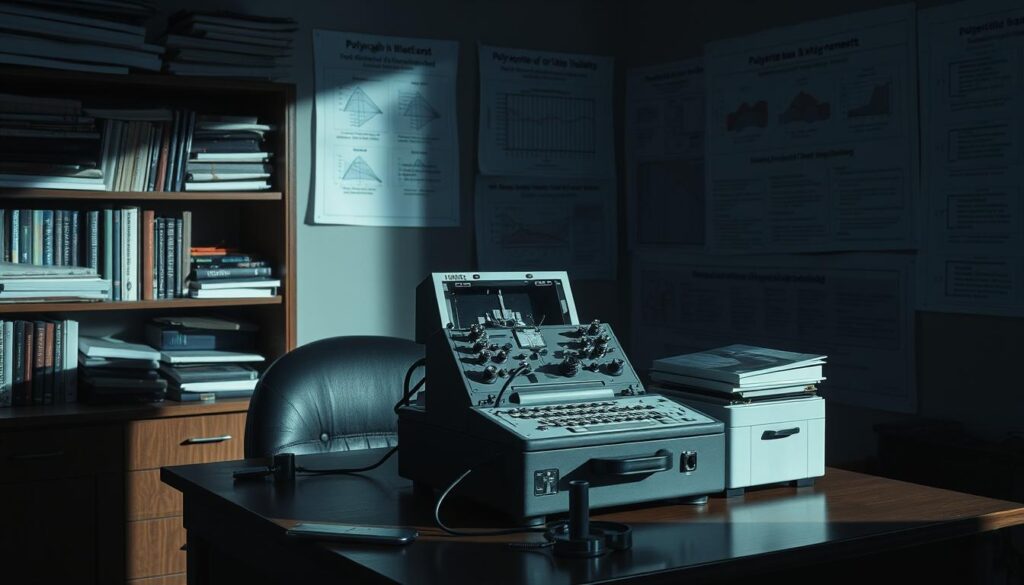
Imagine sitting in a device that looks like something from a 1950s sci-fi movie. Tubes are wrapped around your chest, and a blood pressure cuff is on your arm. Electrodes are stuck to your fingers. This is the world of polygraph basics.
This device, often called a “lie detector,” doesn’t really find lies. It tracks your body’s reactions: your heart rate, breathing, and sweat. But, it doesn’t pinpoint guilt.
It could be that you’re anxious because you’re lying… or because you really need to go to the bathroom. The science behind it is shaky, much like Wonder Woman’s magic lasso.
Let’s look past the myths and see why this old technology is so interesting to law enforcement and scary for job seekers, despite its shaky science.
Brief History of Polygraphy
Imagine a Harvard psychology lab in the 1920s. A young researcher named William Moulton Marston was working there. He would soon create Wonder Woman and the lie detector. What a career change.
Marston found out that blood pressure changes could show if someone was lying. His 1917 paper started polygraph science. But, his peers didn’t support his work.
In 1923, the Frye v. United States case was a big setback. The court said Marston’s invention wasn’t scientifically proven yet. This decision made it hard for polygraphs to be used in courts for many years.
For 70 years, the Frye standard kept polygraph evidence out of courts. But, in 1993, the Daubert decision changed things. It gave judges more power to decide on scientific evidence.
This history is interesting because of the technology’s long-lasting presence. Polygraphs survived years of doubt, like those questionable products on TV.
The path from Marston’s lab to today’s use in interrogations is quite a story. For more on this, check out the polygraph development milestones.
Today, lie detector science is built on this complex history. It mixes early innovation, legal battles, and pop culture. It’s a story that even Wonder Woman’s lasso of truth would find fascinating.
The Science Behind the Test (Measuring Physiological Responses)
Ever wonder how a machine supposedly detects lies? It’s not magic – it’s a collection of sensors measuring your body’s involuntary reactions. The polygraph works on a simple idea: deception causes stress, and stress shows physically. But, the connection isn’t as simple as many think.
How Polygraphs Actually Work
Imagine being hooked up to a 1970s sci-fi prop while someone asks uncomfortable questions. That’s what a polygraph feels like. It tracks your body’s autonomic nervous system responses – those we can’t control consciously. But, modern neuroscience shows we have more control over these responses than polygraph myths say.
The idea is that lying causes a subtle stress state. Your breathing changes, your heart races, and your palms sweat. The polygraph measures these changes through four channels. It’s like having a very attentive nurse watching your stress levels during a tough job interview.

Let’s look at the polygraph’s four sensors. Each tracks a different part of your physiological state during questioning:
- Respiratory patterns: Two pneumatic tubes around your chest and abdomen track your breathing. The idea is that liars change their breathing. But, so do people who’ve had too much coffee.
- Cardiovascular activity: A tight blood pressure cuff on your arm measures heart rate and pulse strength. It looks for the nervous heart’s telltale thump-thump-thump.
- Skin conductivity: Electrodes on your fingers measure how sweaty your palms are. Sweaty palms are thought to mean a guilty conscience – ignoring that the room might be warm.
- Additional respiratory measurements: They double-check breathing because one measurement wasn’t enough.
The real question is whether these measurements show deception or just general anxiety. The science behind polygraph tests shows the link between these responses and deception is not strong.
Think about it: if you’re innocent but nervous about being falsely accused, your body might show the same stress as a guilty person. The polygraph measures arousal, not truthfulness. It’s like assuming everyone who sweats at the gym is lying about their workout.
These polygraph basics show us the technology measures real physiological phenomena. But, interpreting these measurements is more art than science. The machine records data, but humans – with their biases and assumptions – decide what it means.
How Accurate Are Polygraph Tests?
If polygraph accuracy were a dating profile, it would say “complicated” and “it’s not you, it’s me.” We’re about to explore the numbers that make statisticians cry and defense attorneys smile.
The big question isn’t if polygraphs work. It’s if they work well enough to change lives. The answer might keep you up at night.
The Numbers Game
Let’s dive into statistics, where polygraph science either shines or falls apart. The 2003 National Academy of Sciences review was a scientific mic drop: polygraphs are “well above chance but well below perfection.”
That means they’re better than flipping a coin but worse than most courtroom evidence. In labs, where students lie about stealing $20, accuracy hits 80-90%. It’s like being great at free throws when nobody’s guarding you.
But the numbers get really interesting – and scary. Those lab results are like Instagram vs. reality. When you use polygraphs in real life, things start to fall apart.
Real-World Accuracy vs. Laboratory Conditions
Imagine comparing a video game driver to someone driving in Los Angeles during rush hour. That’s the difference between lab tests and real-world polygraph use.
In security screening, the numbers are scary. You might catch 8 out of 10 spies, but you’ll also falsely accuse 1,598 innocent people. Someone who “fails” is likely innocent, making the test almost useless.
Why the huge difference? Field studies overestimate accuracy because of biases. It’s like judging America’s eating habits by only studying food bloggers – you get a skewed view.
| Scenario | Estimated Accuracy | False Positive Rate | Practical Utility |
|---|---|---|---|
| Laboratory Conditions | 80-90% | 10-15% | Moderate for research |
| Specific Incident Investigation | 70-85% | 15-25% | Questionable for evidence |
| Employee Screening | 60-75% | 25-40% | Poor for decision-making |
| National Security Screening | 50-65% | 35-50% | Dangerously unreliable |
The truth about lie detector science? Context matters a lot. In studies, the stakes are low, lies are simple, and everyone knows the script. But in real life, people are nervous, situations are complex, and the stakes are high.
This accuracy gap is why polygraph results aren’t accepted in most courts. They’re not useless, but their error rate is too high for justice systems to handle.
So, when someone says they passed or failed a polygraph, remember: it’s a story mixed with statistical noise that would worry even Nate Silver.
Limitations and Criticisms
If polygraph testing were a Broadway show, it would have closed after the first night. It gets praise in crime dramas, but not from scientists.
Let’s look at why this technology has many flaws.
Scientific and Practical Flaws
The polygraph’s main problem is simple: it measures arousal, not lies. Your sweaty palms could mean you’re hiding secrets or just need to go to the bathroom.
It’s like a weather vane that can’t tell the difference between a storm and a strong gust. The machine records physical responses, but how it’s interpreted is very subjective.
Countermeasures make this science even more unreliable. For example, KGB mole Aldrich Ames passed tests by staying calm and charming his examiners. It’s like cheating on an exam with the teacher’s approval.
The base rate problem makes things even worse. When looking for rare events, tests often give false positives. You’re more likely to find a unicorn than a spy in most places.
Why Even Innocent People Fail
Imagine being punished for having feelings. That’s what happens to innocent people on polygraph exams. The machine doesn’t care why you’re nervous; it just knows you are.
Here are reasons why truthful people might fail:
- Anxiety disorders or general nervousness
- Fear of being wrongly accused
- Medical conditions affecting heart rate or sweating
- Medications or substance use
- Simply being an honest person who hates being suspected
The American Psychological Association has given polygraphy a low credibility rating. They say there’s little evidence it can detect lies.
This is like saying bloodletting might not cure fever. Polygraphy is not just imperfect; it can be dangerous.
Knowing these basics shows why polygraphy is debated in legal and scientific fields. It’s not that the machine lies; it just tells irrelevant truths.
When is Polygraph Testing Appropriate?
Let’s cut through the tension: when does this controversial technology actually serve a purpose beyond dramatic TV moments? The answer might surprise those who view polygraphs as either infallible truth machines or complete pseudoscience.
The reality sits somewhere in the uncomfortable middle. Polygraphs work best when perception matters more than scientific accuracy. It’s the psychological theater that often produces results, not the physiological measurements.
Limited Applications
Law enforcement agencies have mastered this psychological game. They use polygraphs not because the science is flawless, but because suspects believe it works. The mere threat of testing can trigger confessions from the nervous or gullible.
Intelligence communities play a similar game. The CIA and FBI use polygraphs for security clearance screenings, knowing the test’s real power lies in its reputation.
Some employers use them as behavioral deterrents. If employees think they might be polygraphed, they might think twice about misconduct. It’s security theater with possible benefits.
Where Polygraphs Actually Have Utility
The utility emerges in specific, controlled scenarios. Sex offender management programs sometimes use periodic testing as part of treatment compliance monitoring. The test becomes a tool for maintaining accountability.
Certain corporate investigations find value in polygraphs when combined with other evidence. They can help eliminate innocent parties quickly, saving investigation resources.
Some private security firms use them for pre-employment screening, for sensitive positions. The practice remains controversial but persists in specific industries.
| Application Area | Primary Purpose | Effectiveness Rating | Legal Status in US |
|---|---|---|---|
| Law Enforcement Interrogations | Confession Elicitation | Moderate-High | Permitted with restrictions |
| National Security Screening | Risk Assessment | Moderate | Widely used |
| Employment Screening | Deterrence Tool | Low-Moderate | Banned in 19 states |
| Sex Offender Management | Compliance Monitoring | Moderate | Case-by-case approval |
| Corporate Investigations | Evidence Corroboration | Low | Varies by state |
The international perspective reveals how unusual American polygraph culture really is. Most European countries view these tests as violations of the right to remain silent. Canada and Australia heavily restrict their use.
Even within the United States, the patchwork of state regulations tells a story of skepticism. Nearly forty percent of states prohibit polygraph use in employment contexts entirely.
The science of lie detection remains more art than algorithm. The appropriate applications are those where the psychological impact outweighs the need for scientific certainty. It’s less about uncovering truth and more about managing perception – a distinction that makes all the difference.
Misconceptions vs. Facts
Let’s clear up some myths about polygraphs. The device often seen in movies isn’t as perfect as it seems.
Debunking Polygraph Myths
Many think polygraphs can spot lies right away. They can’t. These tests measure how stressed or anxious you are. It’s more about detecting stress than lies.
The idea that polygraphs are 90% accurate? That’s not quite true. Even those who support polygraphs say their real-world results vary a lot. The National Research Council found little proof of extreme accuracy. Research shows that accuracy can be anywhere from 70% to 95%. But, in real life, it’s often lower.
Can you fool a polygraph? Yes, you can. Spies and criminals have been doing it for years. It’s not as hard as it sounds.
Knowing the truth about polygraphs shows they’re not perfect truth finders. They’re actually advanced tools for measuring anxiety, with a better image than real science.