
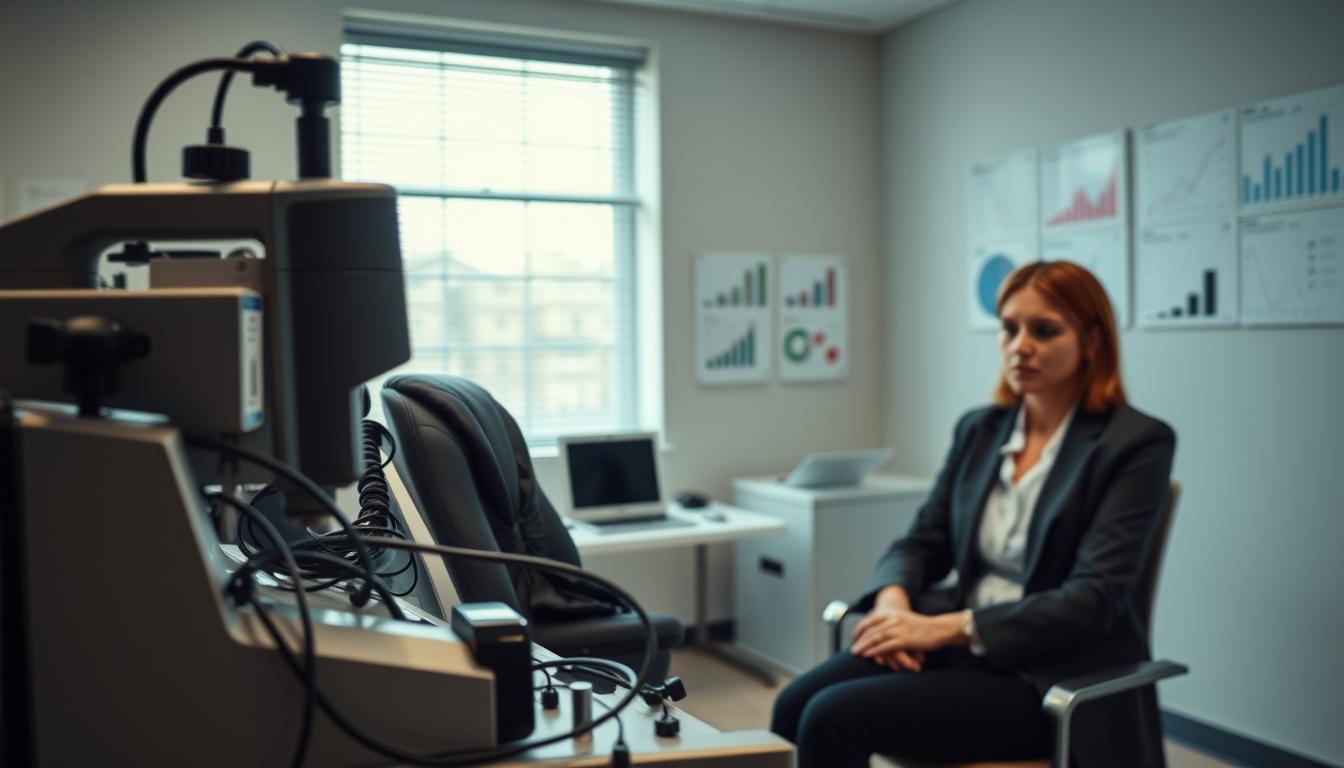
The polygraph, also known as a lie detector, plays a big role in criminal investigations. Its findings can change lives and affect legal decisions. The consequences are huge.
Take Frank Sterling, for example. He failed a polygraph test and was wrongly locked up for 22 years. The real culprit, Mark Christie, passed the test. This shows how wrong a polygraph can be.
Serial killer Charles Cullen also fooled the polygraph. This let him keep killing, adding to his death toll. These stories highlight the dangers of relying on polygraph results.
But, polygraphs have helped solve crimes too. In the case of Annie Le’s murder, suspect Raymond Clark III flunked his test. This gave police a vital clue to follow.
So, how reliable are polygraph tests? They measure physical signs like breathing, heart rate, and sweat. But, many things can affect these readings.
Things like anxiety, stress, and even practice can mess up the results. This has sparked a big debate on polygraph accuracy in legal circles. We need to look closely at the facts behind the figures.
Factors Influencing Polygraph Accuracy
A polygraph’s accuracy depends on a mix of science and skill. It’s not just a number but a range affected by many factors.
The test works by measuring body responses to stress or lies. These responses include heart rate, blood pressure, and skin changes. These signs are the test’s data.
The Pillars of a Reliable Test
For the data to mean something, three things are needed. First, the equipment must work right. Second, the test must happen in a quiet place. Third, a skilled examiner is key.
An expert examiner makes the test valid. They prepare the person before the test and ask the right questions. Their skill turns the data into a clear story.
Many things can mess with the test’s results. The person’s health and mood are very important. Feeling sick, tired, or stressed can change the readings.
Trying to cheat can also mess things up. Actions or drugs to hide feelings can change the results. Learning to control emotions or breathing can also affect the test.
Lastly, a bad or biased examiner can mess up the test. They might ask the wrong questions or misread the data.
| Factor | Impact on Statistical Accuracy |
|---|---|
| Strong Physiological Foundation | Provides a valid, measurable basis for the test, making it more reliable when captured right. |
| Skilled, Accredited Examiner | Makes the test much more accurate by asking the right questions and understanding the data. |
| Controlled Testing Environment | Helps get cleaner data by removing distractions, making the results more trustworthy. |
| Examinee’s Physical/Mental State (e.g., illness, medication, extreme anxiety) | Can add “noise” to the readings, leading to wrong results. |
| Use of Countermeasures (e.g., drugs, physical tricks) | Intends to change the body’s responses, making the test less reliable. |
The table shows polygraph accuracy varies. A good test by a pro is at the high end. But, bad conditions or countermeasures can lower it. So, we must consider these factors when talking about polygraph results.
False Positives and Negatives: How Common Are They?
How often do polygraph tests wrongly accuse the innocent or clear the guilty? This question gets to the heart of the test’s validity. These mistakes are called false positives and false negatives.
A false positive is when a truthful person is seen as lying. A false negative is when a liar is seen as telling the truth. Both kinds of mistakes make people doubt the test’s results.

Real cases show the harm caused by these mistakes. Frank Sterling was wrongly accused of murder after a polygraph test said he was lying. He spent 18 years in prison before being cleared. This is a tragic example of a false positive.
On the other side, Charles Cullen, a serial killer, passed a polygraph while applying for a nursing job. He was later found responsible for many patient murders. Mark Christie also passed a test after committing a violent crime, misleading investigators.
So, how often do these mistakes happen? Supporters and critics have different views. The American Polygraph Association says accuracy is over 90%. But, some researchers think it’s closer to 70%.
This difference is important. Even the higher 90% claim means there’s a 10% chance of error. In serious cases, this rate is too high. It means one in ten results could be very wrong.
The reasons for these mistakes are linked to earlier points. Examiner bias, bad question design, and the subject’s anxiety can lead to false positives. On the other hand, a psychopathic person might not show stress and get a false negative.
The table below shows the two types of errors, their causes, and how they affect the test’s validity.
| Error Type | Definition | Common Causes | Impact on Test Validity |
|---|---|---|---|
| False Positive | Innocent person fails the test. | Examiner bias; subject’s anxiety; poorly worded questions. | Erodes public trust; leads to wrongful accusations. |
| False Negative | Guilty person passes the test. | Subject’s lack of emotional response; countermeasures; examiner error. | Creates dangerous false security; allows guilty parties to go undetected. |
| Overall Implication | Even modest error rates challenge the polygraph’s reliability as a standalone truth-verification tool, specially in legal contexts where consequences are severe. | ||
Understanding these error rates is key. It makes us question the polygraph’s validity more. The test is not perfect. It measures physiological arousal, which can be influenced by many things, not just deception.
When looking at any polygraph result, we must consider the chance of a false outcome. This uncertainty is why most U.S. courts don’t accept polygraph evidence. The risk of error is too high.
Statistical Data on Polygraph Effectiveness
Statistical analysis is key to understanding polygraph reliability. It moves beyond just stories and looks at real numbers. We need to look at the most important studies and their findings.
The American Polygraph Association (APA) did a big study in 2011. They looked at many field studies. They found that 89% of single-issue tests were accurate.
For tests with more than one issue, the accuracy was 85%. But, these numbers are not set in stone. They come with a range, showing where the real accuracy might be.

The accuracy for single-issue tests could be between 83% and 95%. For multi-issue tests, it’s between 77% and 93%. This means the real accuracy could be at either end of these ranges.
It’s also important to know about inconclusive results. The APA study found these in 11% to 13% of tests. When a test is inconclusive, it means the results were too unclear to make a decision. This adds complexity to the overall accuracy.
Critics and some studies say polygraphs are only about 70% accurate. This means they might be wrong nearly one-third of the time. This difference is at the heart of the debate.
The table below shows the main points from the APA study and what critics say:
| Data Source | Reported Accuracy | Confidence Interval / Note | Inconclusive Rate |
|---|---|---|---|
| APA Meta-Analysis (Single-Issue) | 89% | 83% – 95% | 11-13% |
| APA Meta-Analysis (Multi-Issue) | 85% | 77% – 93% | 11-13% |
| Critics’ Estimate | ~70% | Often cited as a mean from selective studies | Varies by study |
Understanding confidence intervals is key. They show that even the best data has some error. For example, an 89% accuracy could actually be as low as 83%. This detail is often missed in discussions.
The rate of inconclusive results also matters. In important situations, an 11-13% chance of no clear answer is big. It means the test might not always give the clear answer people expect.
In summary, polygraph accuracy is not just one number. It’s a range based on study quality and how it’s looked at. The APA data shows moderate reliability, while critics are more cautious about the technology’s use.
Balancing Test Results with Other Evidence
The legal system has a clear stance on polygraph tests. Most U.S. courts don’t accept them as evidence unless both sides agree. This is because there are big questions about how accurate and consistent they are.
Even so, polygraphs are seen as useful tools in investigations. They’re not the final proof but can help find leads. For example, in the Annie Le case, they helped detectives find important clues.
The best way to use polygraph results is with other evidence. This includes physical proof, forensic data, and old-fashioned detective work. A person’s body responses are just one part of solving a mystery. This mix helps figure out the truth better.
New technologies, like Converus EyeDetect, are changing how we check if someone is telling the truth. But, they also face questions about their reliability. Until they’re almost perfect, their results need careful thought.
Polygraph tests can make people confess or show they’re lying. Their real value is in helping with a bigger investigation plan. Experts know to look at the results carefully and with the right context.