

A vehicle disappears just before finance pressure peaks, a burglary claim lists property that cannot be traced, or two insured parties give incompatible accounts of the same loss. Polygraph testing for insurance fraud can help when the file turns on a narrow factual dispute, but its value depends on restraint: it should direct investigation, not decide whether a claim is paid.
That distinction fits the broader professional polygraph framework, where the examination begins with a defined incident, informed consent, carefully reviewed questions, and a clear reporting boundary. In insurance matters, the strongest use case is not proving “fraud” as a legal conclusion. It is testing a specific account that investigators can then compare with documents, digital records, witness statements, and physical evidence.
Why Suspicious Claims Become Credibility Contests
Most questionable claims do not arrive with a confession or a single document that resolves the matter. They develop through mismatched timelines, missing receipts, unexplained delays in reporting, changing descriptions of stolen property, or accounts that conflict with telematics, access logs, photographs, repair records, or witness evidence.
Those indicators may justify closer scrutiny, but they do not prove dishonesty. A legitimate claimant can be confused, distressed, poorly organised, or mistaken about details. The investigative challenge is to separate ordinary inconsistency from deliberate fabrication without turning suspicion into a predetermined conclusion.
A polygraph is most defensible after investigators have already identified a narrow factual dispute. It is far less useful as an early fishing expedition across an entire claim history.
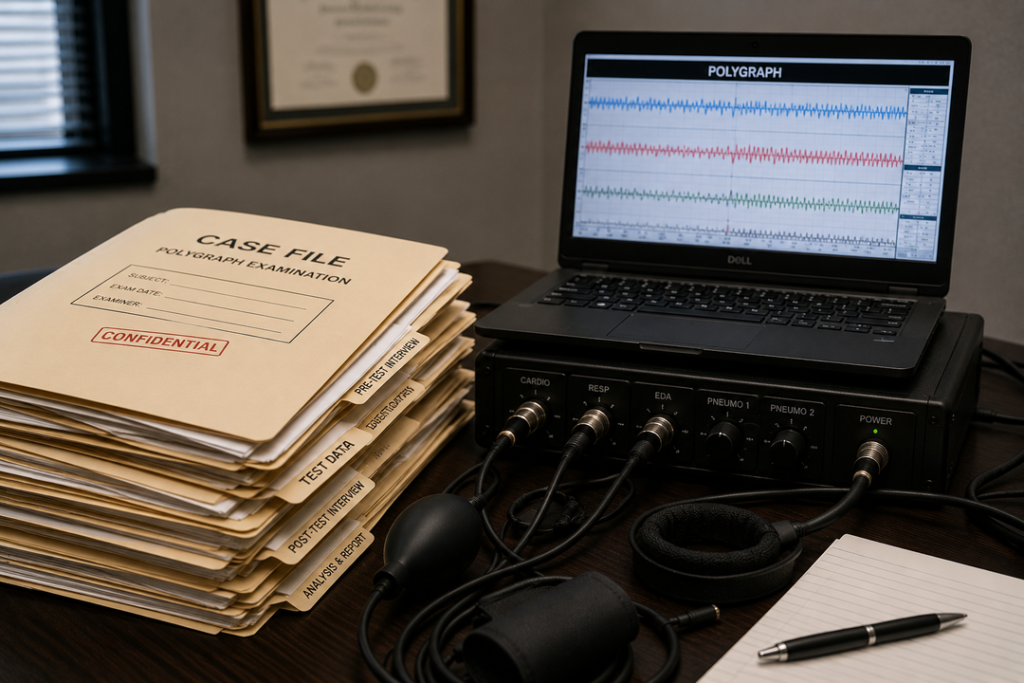
Polygraph Testing for Insurance Fraud Must Stay Narrow
A focused examination should target conduct that is clear, observable, and tied to a defined period. “Did you commit insurance fraud?” is too broad because it asks the examinee to interpret a legal label. A better question addresses one disputed act, such as whether the claimant arranged for a vehicle to be removed, knowingly reported property that was not stolen, or intentionally provided a false account of how damage occurred.
The pre-test interview matters as much as the recorded charts. It allows the examiner to clarify dates, define disputed terms, identify assumptions in the investigator’s brief, and confirm that the examinee understands each question. It may also produce corrections, qualifications, or admissions that are more useful than the final classification.
The discipline is simple: one incident, one material behaviour, and language both sides understand. The result should remain an investigative lead, not a verdict.
What the Examination Can Add to the Case File
The examination should be designed around what the investigator needs to verify next. The table below shows how common claim patterns can be reduced to testable issues without confusing a polygraph result with proof.
| Claim pattern | Narrow issue for examination | Useful investigative outcome | Evidence still needed |
|---|---|---|---|
| Suspected staged loss | Whether the claimant arranged or knew about the loss beforehand | Direct attention to contacts, movements, payments, or communications | Phone records, CCTV, financial records, witness evidence |
| False theft report | Whether the claimant knowingly reported an item or vehicle as stolen | Clarify whether the reported event itself is disputed | Ownership records, location data, recovery evidence, police material |
| Inflated contents claim | Whether specific listed property was knowingly added despite not being lost | Identify which part of the schedule requires verification | Receipts, photographs, valuations, prior inventories |
| Conflicting accounts | Whether the examinee performed one disputed act at a stated time | Narrow follow-up interviews and document checks | Independent statements, timestamps, expert analysis |
The practical benefit is prioritisation. A result may suggest where to seek corroboration, which timeline needs rebuilding, or whether an alternative explanation deserves attention. It cannot establish policy liability, quantify loss, prove criminal intent, or replace the insurer’s obligation to assess all relevant material.
Investigative Value and Admissibility Are Separate Questions
A useful investigative tool is not automatically lawful for every insurance purpose, and it is not automatically admissible in a dispute. Admissibility is jurisdiction-specific, while privacy, consent, data handling, contractual fairness, and claims-handling duties can create separate restrictions before a test is even arranged.
New South Wales is especially clear. The state’s statutory restrictions on lie detectors expressly include consideration of an insurance claim among prohibited purposes and separately render lie-detector output inadmissible before courts and other bodies authorised to receive evidence.
That rule should not be generalised mechanically to every jurisdiction, but it shows why legal review must come first. An insurer, investigator, lawyer, or claimant considering a test in Australia or New Zealand should confirm local law, the proposed purpose, the consent process, and how any report could lawfully be stored, shared, or used.
Decision-Making Pressure Points Insurers Cannot Ignore
Even where testing is legally available, the insurer still owns the claim decision. The file must stand on policy terms, verified facts, expert reports, records, interviews, and a procedurally fair assessment. A polygraph result should never become a substitute for identifying the contractual basis for acceptance, reduction, or denial.
That caution aligns with current claims investigation standards, which place claims handling and investigations within a framework of openness, fairness, honesty, communication, and defined processes. A responsible workflow uses the examination to generate follow-up tasks: verify a phone contact, retrieve footage, compare inventory records, reinterview a witness, or test an alternative timeline.
Several warning signs should stop the process. These include coercive consent, questions built on unverified assumptions, pressure to test multiple allegations at once, treating an inconclusive result as deception, or allowing investigators who formed the original suspicion to interpret every later fact through the same lens. The safeguard is independent corroboration and a documented explanation of how each piece of information affected the decision.
The Right Measure Is What Happens Next
The strongest polygraph examination does not close an insurance fraud file by itself. It makes the next investigative step more precise, while preserving the difference between suspicion, physiological response, verified evidence, and the insurer’s final reasoning.
Used within those limits, polygraph testing for insurance fraud can add structure to cases involving staged losses, false theft reports, questionable claim schedules, and conflicting accounts. Used as a shortcut, it can distort the investigation, expose the decision-maker to legal and procedural risk, and weaken the very case it was meant to clarify.