

Can a machine really tell when you’re lying? Welcome to the fascinating world of deception detection. Here, science meets psychology in a real-life episode of “Lie to Me.”
These clever devices don’t actually detect lies directly. They’re sophisticated stress detectors. They measure everything from your racing heart to your sweaty palms. The technology has evolved from 19th-century prototypes to today’s computerized systems. These would make Q from James Bond proud.
The core theory suggests deceptive answers produce distinctive physiological responses. These include changes in heart rate, blood pressure, breathing patterns, and skin conductivity. It’s like trying to measure guilt through medical equipment and psychological profiling.
Here’s the million-dollar question: Are we measuring anxiety, stress, or actual deception? The experts at Polygraphianz have spent years refining this delicate balance. They mix technology with human interpretation.
The modern polygraph process remains one of society’s most controversial attempts to quantify truth. It’s the psychological equivalent of diagnosing a cold by counting sneezes. It’s brilliantly simple yet endlessly debatable.
Breakdown of Each Stage (Pre-Test, Test, Post-Test)
Ever wondered what happens in a polygraph test? It’s not like a sci-fi movie, but it’s not just a normal job interview. It’s more like a three-part psychological symphony where your body’s involuntary responses are the main instrument.
The pre-test interview is where the magic starts. It’s not just about filling out forms and saying hello. It’s about getting to know you and setting a baseline. Your examiner will study your normal body responses and explain everything to you. They might even do a “stim test” where you lie on purpose. This is to show the machine works and see how your body reacts to lying.
Next, it’s time for the main event. You’ll be hooked up with sensors like in a NASA experiment:
- Galvanic skin response sensors measuring sweat
- Blood pressure cuff monitoring cardiovascular changes
- Respiration belts tracking breathing patterns
The questions you’ll face come in three types, each with its own purpose:
| Question Type | Purpose | Example |
|---|---|---|
| Irrelevant | Establish baseline | “Is today Tuesday?” |
| Control | Measure reaction to lying | “Have you ever told a white lie?” |
| Relevant | Target investigation | “Did you take the missing funds?” |
After the test, the examiner analyzes your responses. They look at your body’s reactions like an art critic. They’re searching for signs of truth, deception, or unclear results. This is where the raw data turns into a professional judgment.
Throughout the whole process, remember it’s not magic – it’s science. Your body’s nervous system is the star of the show, showing truths your mind might hide. The whole thing usually takes 2-3 hours, with the actual questioning part lasting about 30 minutes.
So, what can you expect? A detailed, scientific process that combines science and psychology. The machine measures your responses, but a human examiner tells the story your body is telling.
Sample Script
The polygraph script is not just any interrogation. It’s a detailed psychological dance. Imagine it as a therapy session where your body’s responses are the stars.
Each question has a purpose in this lie detection show. The examiner doesn’t ask random questions. They follow a plan to see how your body reacts honestly.
Let’s look at the three parts of this psychological play:
- Irrelevant questions: These are the opening acts. “Is today Tuesday?” “Are you breathing?” They show how your body acts when there’s no emotional stress.
- Control questions: Now, the game gets serious. These questions are meant to make anyone feel guilty. Think “Have you ever told a white lie?” or “Did you ever cheat on a test?”
- Relevant questions: This is the climax. They directly ask about the case – “Did you take the missing funds?” The examiner compares your body’s reactions to these and the control questions.

The magic is in how the questions are mixed. The examiner switches between types, watching your body’s reactions closely. It’s like comparing your response to stealing cookies as a kid versus the current accusation.
This isn’t about catching you in a lie. It’s about seeing how your body reacts differently to each question. Your body gives away truths through your pulse, sweat, and breathing, even if you try to hide it.
The whole script relies on one key fact: your body can’t tell the difference between past guilt and current accusations. That cookie you stole as a kid might feel just as guilty as the bank heist you’re accused of today, thanks to a skilled examiner.
Rights of All Parties
Welcome to the world of lie detection, where your rights and science meet. The polygraph test is like a machine that reads your body’s signs. But, it’s not as scientific as it seems.
Here’s the key fact: you usually have the right to say no to a polygraph test. But, like all rights in America, it’s not that simple. There are many rules and possible outcomes that might confuse you.
The Supreme Court says polygraph evidence is not very reliable. This is why it’s rarely used in court. But, the test can be used to get confessions and gather information.
It’s like a truth serum that doesn’t really work but is used all the same. The laws around it are confusing and seem to change often.
States have their own rules for polygraph tests:
- Some ban employers from using them
- Others allow them but with rules
- Government jobs might see refusal as a big problem
- Private jobs have different rules than public ones
The Employee Polygraph Protection Act (EPPA) stops most private employers from using lie detectors. But, government jobs are different. They often use them for national security reasons.
To know your rights, you need to check your state’s laws on polygraph tests. Some states see them as tricks, while others give them some legal power.
Even if you can say no, refusing might hurt your job. It’s a tough choice: protect your privacy or risk losing your job. The polygraph test is part of America’s tradition of balancing rights and needs.
So, what’s the main point? The machine gets more protection than you do in many cases. The polygraph test is used because it works, not because it’s scientifically proven. In America, pressure can sometimes get better results than truth.
Accuracy & Limitations
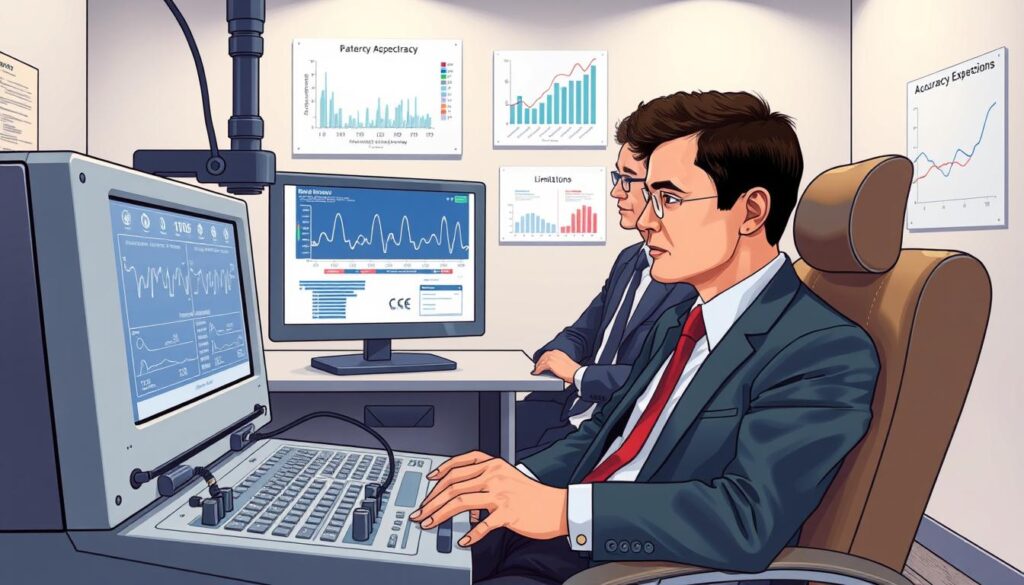
Let’s get real about polygraph tests. The American Polygraph Association claims an 87% accuracy rate. But think about it, that’s like a weather forecast being wrong 13% of the time. You’d always carry an umbrella.
The National Academy of Sciences gave a harsh review. They said polygraph accuracy is as solid as a horoscope. Why? Because they measure how stressed you are, not if you’re lying. It’s like trying to find a heart problem by counting sneezes.
- Examiner experience: A new examiner might confuse nervousness with lying
- Your physical state: Things like cold medicine or caffeine can mess up the results
- Countermeasures: Some people can trick the machine by thinking differently
- Anxiety disorders: Your anxiety might look like guilt to someone who doesn’t know better
The machine can’t tell the difference between guilt and being wrongly accused. It’s like a smoke detector that goes off for both fires and birthday candles.
| Factor | Impact on Accuracy | Real-World Example |
|---|---|---|
| Examiner Skill | High variability | 20+ years vs. 6 months experience |
| Test-Taker Physiology | Major influence | Medications, heart conditions |
| Countermeasures | Can defeat test | Aldrich Ames case |
| Anxiety Sources | Cannot differentiate | Guilt vs. test anxiety |
False positives are a big problem with these tests. Imagine being seen as dishonest because you had coffee. Or think about people who are sociopaths and pass the test without any issues.
The harsh truth is, polygraphs are better at measuring stress than lies. They’re like psychological thermometers that can’t tell the difference between fever and hot flashes. What to expect really depends on whether you trust a machine that confuses nervousness with dishonesty.
Confidentiality
Welcome to the world of lie detection where secrets are supposed to be safe. But, the fine print is like a Kafka novel. The polygraph exam seems like a private talk between you, the machine, and the examiner. Yet, behind the scenes, there’s a complex data-sharing system that surprises even privacy experts.
Your polygraph results are meant to stay private between the examiner and the agency asking for them. This makes it seem like a private chat, like a doctor-patient talk. But this doctor might have to testify against you in court. The agreement you sign has many exceptions, like a prenup from a divorce lawyer.
Law enforcement and government agencies have different rules than a therapist’s office. National security can make your body’s responses government property quickly. Your results might go through secret databases, shared easily among agencies.
The rules for polygraph data are like Swiss cheese – full of holes and exceptions. What’s private in one state might be public in another. Legal cases can make your data public, showing your nervous signs in court.
Here’s the really scary part: how your data is used and stored. A false positive doesn’t just vanish. It can affect your security clearances, job chances, and government records. The machines might be questionable, but their findings are permanent records you can’t change.
Professional examiners know how to handle these issues. They follow best practices for confidentiality and security in polygraph tests. They try to balance legal needs with ethics, working in systems that often favor security over privacy.
The real question is not if your results are private now. It’s if they’ll stay private in the future, when laws or administrations change. In lie detection, keeping your secrets safe is not a promise but a hope.
Your body’s responses are data in a system that values security over privacy. The agreement you sign is more of a hope than a promise. It’s the hope that your most private moments won’t be used against you.
FAQs
Let’s tackle the questions everyone whispers about polygraphs. Can you outsmart these truth-seeking machines? The short answer: yes, you can.
History’s most notorious spies outsmarted them for years. They used psychological tricks and physical interventions that would make a Hollywood stunt coordinator blush.
Can medications affect results? Yes, they can. Beta-blockers and that triple espresso you had can make the needles dance. The machine can’t tell the difference between chemical interference and deception.
What if you’re naturally anxious? Congratulations – you might fail while telling the truth. The polygraph measures physiological responses, not intent. It can’t tell guilt nerves from performance anxiety or general nervousness.
How long does the ordeal take? It can take anywhere from 30 minutes to several hours. The actual test is just the end of a long process.
Are results admissible in court? Generally not in US federal courts. This shows how much they’re trusted. Most states also limit their use. The scientific community views polygraph accuracy as low as astrology readings.
For more detailed answers, visit our FAQ page. We explain the polygraph process with humor and facts.
The most important question is: should you trust the results? Let’s say the machine measures physiological responses, not truth. It’s like trying to diagnose a software bug by measuring your laptop’s warmth.
Result Communication
When the squiggly lines stop moving, the examiner starts to analyze your body’s signals. They look for changes in heart rate, skin conductance, and breathing. It’s all about science, not drama.
The results are sent to the agency with a score showing how likely you lied. You might have to explain any odd responses. It’s like your body’s sweat level is graded.
The American Polygraph Association says accuracy can vary a lot. Some places claim 86-100% accuracy, but others see the limits of the test.
This moment is where science meets real life. A wrong result can lead to big losses like a job or freedom. It’s a big responsibility for those squiggly lines.