

Let’s go back to 1988. It was a time of big hair, synth-pop, and President Reagan signing the Employee Polygraph Protection Act (EPPA). This law was a big deal. It marked a shift in how employers could question their workers.
Before the EPPA, bosses could use lie detectors freely. But the new law changed all that. It made sure employers had to follow strict rules when using these machines.
The law mainly stopped employers from using polygraphs in most cases. It was meant to protect workers from unfair firings or hiring practices. So, what does this mean for today’s workplace?
The EPPA set clear rules for when polygraphs can be used. It’s like a game of Operation, where one mistake can cost $10,000. Employers and employees must navigate these rules carefully.
This creates a complex situation. Employers want to be sure about their employees, but workers have the right to privacy. The question is, when can a polygraph be used legally? The answer is quite specific.
Safety/Security Industry Exemptions
Imagine a law that treats a bank teller and a nuclear facility guard differently. Welcome to the world of polygraph exceptions. The Employee Polygraph Protection Act (EPPA) isn’t for everyone. It protects most of us from intrusive questions but not everyone.
Why the special treatment? It’s because some jobs are more critical. A lie in these roles could be catastrophic. So, the law trades privacy for security.
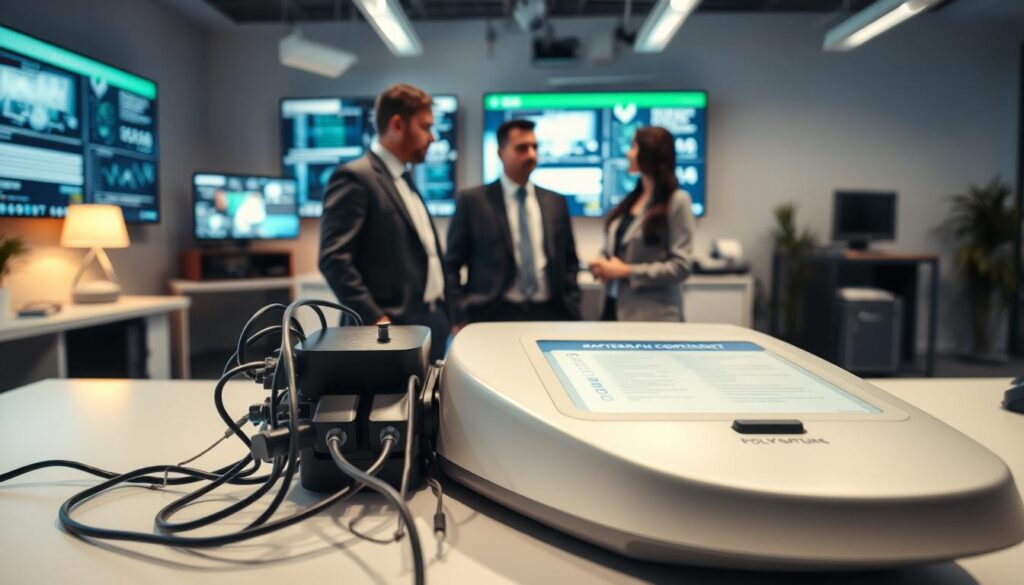
The EPPA gives special treatment to a few. It’s based on job risk. Let’s see who’s in.
First, government agencies. Police, schools, and prisons have more freedom. They say it’s for public safety.
Next, companies with federal contracts for sensitive work. This includes counterintelligence. The government needs all tools, including polygraphs.
Then, there are the protectors of our infrastructure. The EPPA makes big exceptions for:
- Armored car personnel: Those moving millions in cash. Trust is key here.
- Security personnel for high-impact facilities: Not just any guard. We’re talking nuclear plants and toxic waste sites. A mistake here is a disaster.
Companies that handle controlled substances also get a pass. This includes major pharmaceuticals. A dishonest employee here risks public health crises.
This creates a two-tiered workforce. For most, polygraphs are TV show relics. But for some, like armored car drivers, they’re a reality. These exceptions are not loopholes but deliberate choices. They show what the law fears most: not personal shame, but system failure.
So, while Joe from Accounting sleeps soundly, others do not. The EPPA’s protections have clear, high-stakes borders. Knowing these exceptions is about understanding privacy and public need.
Pre-Employment Testing vs. Investigations
The Employee Polygraph Protection Act is like a strict bouncer. It only lets certain people in. For most private businesses, pre-employment employer screening is like showing up in sweatpants—it’s not allowed.
There’s a big difference in polygraph law. On one side, you have pre-hire testing. This is when employers check if you’re honest before hiring you. But, under federal law, this is mostly banned for private jobs. The EPPA sees it as unfair, like fishing without a target.
Across the gap, there’s ongoing investigations. This part of the law is more interesting, but only if employers follow strict rules. It’s not about random doubts. It’s about specific crimes like theft or drug use at work.

The rules for investigations are clear. There must be a clear loss, like missing items. The person in question must have had access to it. And there must be strong reasons to suspect them. It’s not a random search; it’s a focused inquiry with specific conditions are met.
Here’s a legal twist. Even if all the conditions are met, employers cannot force employees to take the test. Saying no can’t lead to any job penalties. So, it’s more like a game of psychological chess—a way to find the truth, but with the employee’s choice to refuse.
The main difference is between a banned fishing trip and a legal detective story. One is too much power for employers; the other is a controlled way to find specific wrongdoings. Knowing this is key for businesses thinking about types of polygraph exams in the workplace.
Remember: you can’t screen employees before hiring them. But, a proper investigation is a different story. It has strict rules, clear needs, and the employee’s right to leave anytime.
Documentation Needs
So you’ve cleared the legal hurdles. Now comes the real test: the paperwork. The Employee Polygraph Protection Act (EPPA) doesn’t just permit a polygraph test—it demands a documentary ballet. Every step is choreographed in ink.
First, the employer must serve the employee a signed dossier. This written statement details the company, the alleged loss, the employee’s access, and the specific reason for suspicion. It’s not a hunch; it’s a formal accusation.
Then, the clock starts. The employee gets 48 hours’ advance written notice of the test, minus weekends and holidays. Even suspicion gets a weekend off.
The polygraph examiner steps into a role more regulated than a bartender. They need state licensing, hefty insurance, and must provide written explanations of every right and procedure. They’re capped at five tests a day, each lasting at least 90 minutes. Deceit detection is exhausting work.
Every question, every squiggle on the chart, becomes part of a file that must be retained for three years. Results are delivered in writing. This mountain of paper isn’t red tape—it’s armor. It protects the employee with transparency, shields the examiner from lawsuits, and gives the employer a defensible record. Skip one form, and your “reasonable suspicion” becomes the employee’s slam-dunk lawsuit. In the end, the pen proves mightier than the polygraph needle.
This bureaucratic rigor echoes principles found in laws like Ontario’s Employment Standards Act, which outright bans such tests, highlighting a fundamental distrust of the machine’s place at work.