

Imagine the seventh floor of the J. Edgar Hoover Building. It’s where America’s most secret information is kept. Now, picture walking in there not because you passed a tough test, but because you knew someone important.
Director Kash Patel made a big move by letting senior staff skip polygraph tests. It wasn’t just a small talk. It showed why checking for integrity is key.
As you rise in leadership, your past and honesty become more important. Executive vetting is like a shield for your organization. Skip it, and trust can start to break down.
This is at the core of measuring integrity in leaders. A leader without tested integrity is a risk. They’re not just a choice, but a danger waiting to happen.
Screening Process Overview
A leadership screening polygraph isn’t like a spy thriller. It’s not about sweating suspects or dramatic needle spikes. It’s more like a detailed dig into a candidate’s past, not a trap for lies.
Its main value in leadership screening is called “incremental validity.” This means it adds important insight that other tools might miss. A resume shows achievements, references praise, and a fingerprint check reveals criminal records. But, it also uncovers unknown transgressions.
This truth machine works by measuring body responses to questions. It’s not about finding a lie detector reading. Instead, it creates a biometric stress map focused on specific topics from your past. The goal is to analyze your body’s reactions to certain questions.
At the heart of this process is a big challenge. No test is perfect. You must understand the test’s sensitivity, specificity, and base rate.
- Sensitivity: The test’s ability to correctly identify deceptive individuals.
- Specificity: Its ability to correctly identify truthful individuals.
- Base Rate: How common deception actually is in your candidate pool.
Get these wrong, and you might wrongly accuse someone or let a liar pass. It’s all about finding a balance in probability.
Let’s look at what different screening tools reveal:
| Screening Method | What It Reveals | Analogy | Key Limitation |
|---|---|---|---|
| Background & Fingerprint Checks | Documented, *known* history (employment, criminal records). | The official biography. | Only shows what’s already on the public record. |
| Reference Interviews | Curated perceptions from provided contacts. | The letter of recommendation. | Subject to bias, flattery, or limited knowledge. |
| Leadership Screening Polygraph | Insight into *unknown* or unreported past behaviors. | The unauthorized biography. | A probabilistic tool, not a definitive verdict. |
The modern polygraph, born in the 1930s, has evolved into a sophisticated tool. It’s not the only way to find truth but adds valuable data. It asks questions references won’t and fills in the gaps left by records.
Using a polygraph in executive vetting shows we understand human complexity. It’s about using past behavior, even the hidden kind, to predict future actions. It’s not about prophecy but improving the odds, one response at a time.
Questions for Sensitive Roles
Creating polygraph questions for leaders is like a delicate surgery. It needs the skill of a neurosurgeon and the insight of an economist. It’s not a casual chat but a deep dive into a person’s psyche.
The art of crafting Polygraph for Leadership questions is both magical and challenging. A poorly phrased question can cause more harm than good. Questions must be clear, well-defined, and answerable with a simple yes or no.
Consider this: “Are you trustworthy?” is a complex question. But “Did you ever falsify financial records between 2015 and 2020?” is straightforward. It targets specific behaviors linked to integrity issues, known as actuarially derived predictors.
| Question Category | Operational Purpose | Example Framework | Leadership Relevance |
|---|---|---|---|
| Criminal History | Identify past unlawful behavior patterns | “Prior to age 30, did you commit any felony not disclosed on your SF-86?” | Predicts compliance with legal frameworks |
| Substance Abuse | Assess judgment and dependency risks | “Did you use illegal drugs without a prescription after 2018?” | Indicates impulse control and decision-making |
| Foreign Contacts | Evaluate vulnerability to external influence | “Have you had unauthorized contact with foreign intelligence officers?” | Tests loyalty and discretion under pressure |
| Information Security | Gauge respect for classified protocols | “Did you ever discuss classified material in an unsecured setting?” | Reveals core adherence to governance structures |
Leadership screening traditionally focuses on drug use, criminal history, foreign contacts, and classified information handling. These are the essential checks for a security clearance. But, the questions have recently taken a new turn.
Now, some federal employees are asked if they’ve spoken negatively about their bosses. Yes, criticizing the boss has become a polygraph question. It’s a way to check loyalty within the organization, not just legal compliance.
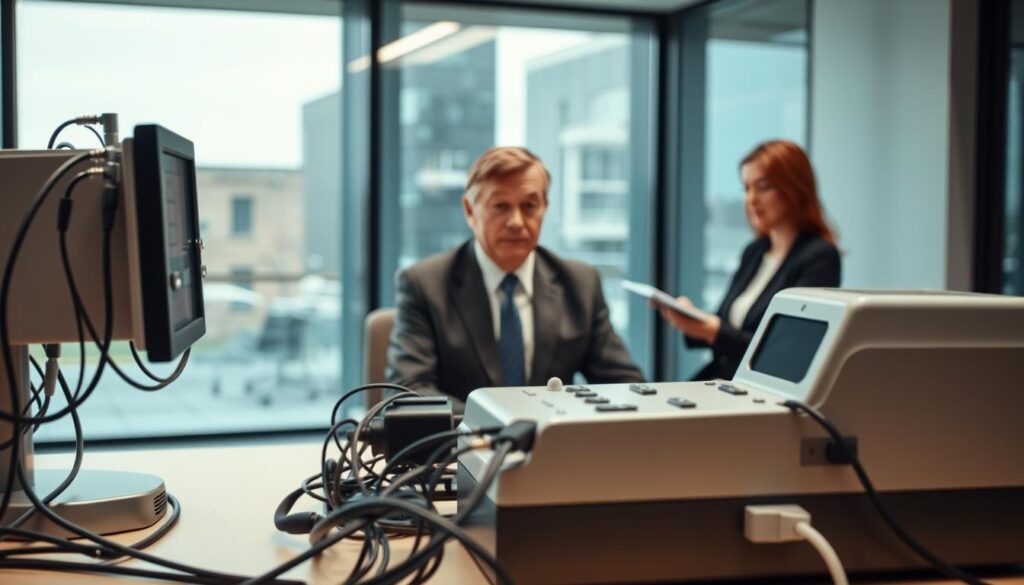
This shift shows something important. The questions reflect what an organization fears most. Is it espionage, corruption, or maybe internal dissent?
For those going through this, it’s key to understand the questions’ purpose. A guide on polygraph test questions for government jobs can offer valuable insights. The goal is not to memorize answers but to grasp the psychological landscape being explored.
Leadership polygraph questions aim to uncover the real story behind a resume. They seek the honest history that a CV might hide. This way, they build a risk versus reliability profile, one yes/no answer at a time.
Combining Polygraph with Reference Checks
The polygraph test alone is like listening to just one instrument in a symphony. You might hear a melody, but you’ll miss the full sound. In executive vetting, using only the polygraph is seen as outdated. It’s better to look at the whole picture.
Think of it as seeing a candidate in 3D. The polygraph looks at what’s hidden. Reference checks examine what’s shown. Together, they give a clear view of a candidate.

The lie detector isn’t a magic solution. It’s a tool for finding clues, not making decisions. Using it alone is like fixing a car without checking the whole engine.
This approach focuses on the whole person. The polygraph might uncover secrets. A reference check can confirm or explain these findings. This way, you get a complete view of a candidate.
| Vetting Method | What It Reveals | Key Strength | Key Limitation |
|---|---|---|---|
| Polygraph Assessment | Undisclosed behaviors, concealed information, physiological responses to stress | Probes subconscious and hidden truths | Can’t distinguish nerves from deception without context |
| Reference Checks | Social reputation, professional performance, peer observations | Validates public persona and work history | Relies on others’ willingness to be candid |
| Criminal Record Check | Documented legal history, court records, public violations | Confirms known, verifiable facts | Misses everything that never reached official channels |
| Combined Approach | The complete picture: hidden + public + documented | Creates context and verifies signals across sources | More time-intensive and requires expert integration |
Each method has its blind spots. The polygraph misses social context. References overlook private truths. Criminal checks ignore everything not documented.
Police psychologists are great at combining these insights. They’re trained to understand complex signals. For executive vetting, you need someone who can interpret both the polygraph and reference checks.
Here’s how it works in real life. A candidate shows signs of dishonesty about money. The polygraph flags this. Instead of dismissing them, you investigate further. Former colleagues and audits reveal more.
The best strategy uses both tools. As one introduction to workplace polygraph testing notes, they should inform each other. The polygraph finds anomalies. Reference checks provide context.
This isn’t just about catching dishonesty. It’s about understanding people. Some nervousness is normal. Some past mistakes can be explained. The combined approach helps separate important issues from human flaws.
Remember, the goal isn’t perfection. It’s finding candidates whose whole story fits your organization. The polygraph offers one view. Smart vetting gives you the full picture.
Maintaining Discretion
Let’s clear up the mystery. Discretion in leadership checks isn’t about secret meetings in fancy rooms. It’s about the behind-the-scenes work that keeps secrets safe. When we talk about a Polygraph for Leadership, we’re not just checking someone’s past. We’re testing the system that protects sensitive information.
Think of sensitive information as the VIP area of national security. The polygraph is like the door guard. It’s the test you must pass to enter. Now, imagine if the door guard let some people in without checking. That’s what happened in the FBI’s Security Division.
This shows how discretion fails. It fails not when a secret leaks, but when the rules are ignored. Giving a waiver is like saying rules don’t apply to everyone.
The real issue is often the decision to ignore rules before they’re even checked. A strong confidential testing process must be strict. If not, it becomes a show of who’s important, not a security tool.
So, what does keeping discretion mean in real life? It means following rules over personal connections. The table below shows the difference between a fair system and one that favors some.
| Principle | Discreet, Systemic Approach | Compromised, Hierarchical Approach |
|---|---|---|
| Core Function | Protects the integrity of the information ecosystem. | Protects the comfort and status of senior individuals. |
| View of the Polygraph | A non-negotiable systemic safeguard and equalizing ritual. | A negotiable hurdle, subject to waiver based on rank or convenience. |
| Signal to the Organization | Security protocols are foundational. Everyone is accountable. | Rules are hierarchical. Some are above the process. |
| Long-term Risk | Minimized. Trust is built on verified, standardized procedures. | Amplified. Creates cultural rot and insider vulnerability. |
| Outcome for Leadership | Legitimacy earned through verified transparency. | Authority undermined by perceived (or actual) special treatment. |
The FBI complaint is a warning sign. It shows the foundation is cracking. For a leader, going through the process shows they stand with the system. It means they are not above the law they enforce.
Keeping discretion means protecting the process that protects everything. When the Polygraph for Leadership is fair, it’s not just a test. It’s a public promise to uphold the system. The waiver is not just for an executive. It’s a sign of a lack of imagination about what real security means.
Potential Outcomes
Think of a polygraph in leadership screening like a high-stakes poker game. You’re not just looking for a simple “pass” or “fail.” You’re analyzing four possible hands. The ideal outcomes? A True Negative means your honest candidate is cleared. A True Positive means you’ve caught a deceptive player before they join your team.
The other two hands are where the real drama unfolds. A False Positive is a bad beat. You misread an honest person’s nerves as deception. You lose a good candidate and tarnish their name. A False Negative is the ultimate bluff. A slick operator passes the test and gets the keys to the kingdom. This is the catastrophic risk.
Here’s the statistical rub. If deception in your elite pool is rare, even an accurate polygraph will generate more false alarms than true catches. This isn’t a flaw. It’s a feature that defines its proper use.
The real power of this tool in leadership screening isn’t as a final judge. It’s a catalyst. An inconclusive or positive polygraph result isn’t a verdict. It’s a bright red flag. It signals the need for a forensic deep dive into references, past work, and digital footprints.
In the end, a polygraph offers strategic intelligence, not a simple answer. It adds a critical layer of data to your decision-making process. Your goal isn’t just to fill a role. It’s to build a leadership team with unshakable integrity. Every piece of intelligence counts.