
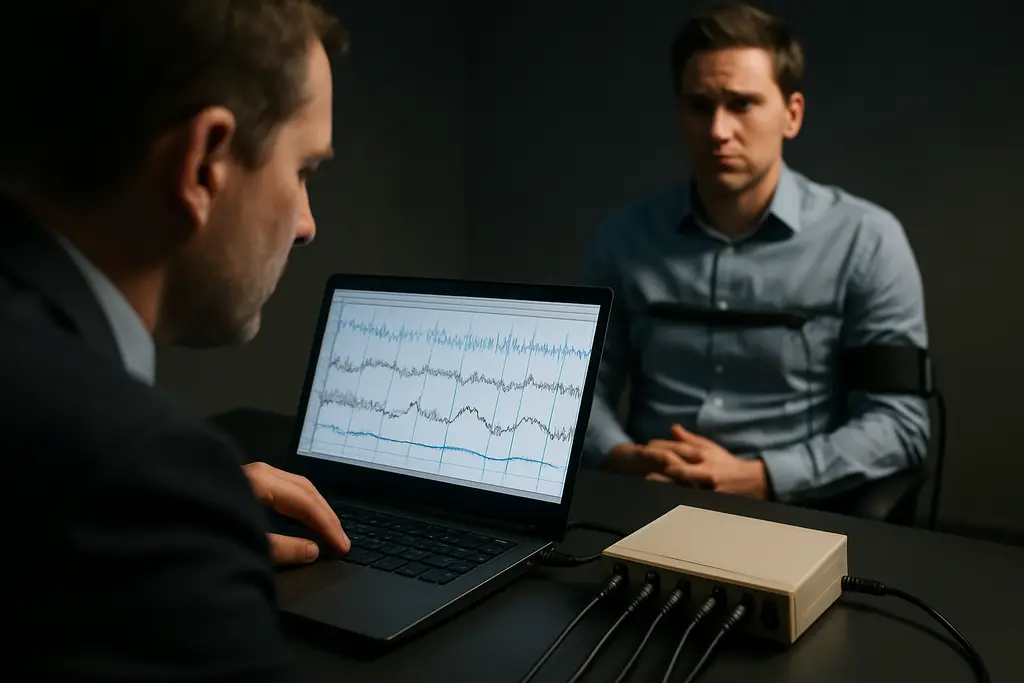
Polygraph Ethics matters most when the decision is serious enough to affect a person’s job, liberty, reputation, or professional future. In workplace integrity matters, a polygraph may be considered during a sensitive inquiry into theft, embezzlement, security concerns, or misconduct. The ethical problem is not that the instrument has no investigative value. The problem is that its value is conditional, its error risk is real, and its use can create pressure that outpaces the evidence.
A polygraph records physiological responses associated with factors such as breathing, cardiovascular activity, and perspiration. Those data points do not directly measure truth. They require interpretation within a structured testing method, with clear limits on what the result can support. In high-stakes investigations, the examiner, employer, investigator, and decision-maker all need to avoid presenting the result as a stand-alone verdict.
Polygraph Ethics And The Risk Of Overconfidence
Why Polygraph Ethics Starts With Limits
Polygraph Ethics begins with a practical admission: the test is an investigative tool, not a direct truth detector. Research summarized for this topic shows wide variation across polygraph methods, settings, and populations. Some event-specific studies report stronger performance than broader screening uses, while older foundational reviews and later analyses also identify false positives, false negatives, and inconclusive outcomes. That variation is ethically significant because a high-stakes investigation rarely gives people the protection of low consequences.
Overconfidence can enter the process in several ways. An investigator may treat a chart interpretation as confirmation of an existing theory. A manager may view a reported deception outcome as enough to end employment. A subject may experience the process as proof that resistance is futile, even when the underlying evidence is thin. Each of those risks grows when the polygraph is presented with more certainty than the science or law supports.
The Problem With Pressure After A Result
The September 2026 research described in the provided materials is especially concerning because it examined exonerees who had falsely confessed and had been polygraphed during interrogation. The reported pattern was not only about test accuracy; it also involved how results were communicated. In the cases described, suspects were often told the polygraph indicated deception, including situations where the result was inconclusive or exculpatory. For workplace leaders, the lesson is direct: how a result is framed can be as ethically important as the result itself.
In an employment investigation, the same pressure can appear in less dramatic but still harmful forms. A worker may believe that disagreement with the examiner’s interpretation will be treated as defiance. A supervisor may infer guilt from anxiety, reluctance, or an inconclusive result. A compliance team may allow the test to shift attention away from documents, access logs, inventory records, witness statements, and other evidence that can be independently checked.
Legal Limits In Workplace Testing
Federal Employment Restrictions
In the United States, workplace use of polygraph testing is not a free-choice management tool. The Employee Polygraph Protection Act of 1988 generally prohibits most private employers from using lie detector tests for pre-employment screening or during employment, subject to specific exemptions and conditions, according to the U.S. Department of Labor’s EPPA guidance. Those limits are central to ethical practice because legality and consent cannot be treated as paperwork after the decision has already been made.
The research notes also describe state-level restrictions and updates affecting employment screening laws in several states through mid-2025. That creates an added compliance issue: a process that appears permissible under one framework may still be restricted under another. Employers should not treat this article as legal advice. A prudent workplace integrity program should involve qualified legal review before any testing decision is made, especially where the investigation involves discipline, termination, referral to law enforcement, or regulated positions.
Admissibility Is Not The Same As Usefulness
Court treatment of polygraph evidence also supports caution. In United States v. Scheffer, the U.S. Supreme Court upheld Military Rule of Evidence 707, which prohibits admission of polygraph results or opinions in courts-martial, as summarized in the military justice evidence digest on polygraph evidence. That does not mean every workplace inquiry follows courtroom evidence rules. It does show that legal systems have long been wary of giving polygraph results the status of ordinary proof.
The ethical distinction is simple: a result may help generate investigative leads, but that does not make it fair to use as the decisive fact. High-stakes decisions should rest on evidence that can be explained, tested, and challenged. Polygraph outcomes are harder for non-specialists to evaluate, which increases the responsibility of the examiner and employer to describe what the result can and cannot mean.
Accuracy, Error, And Human Harm
False Positives And Inconclusive Outcomes
Polygraph Ethics requires direct attention to error. The research supplied for this article reports false positive concerns in specific-incident testing and notes that some criminal investigation populations show higher rates than others. It also reports that event-specific diagnostic testing has produced stronger aggregate results than multiple-issue testing in some reviews, but with meaningful inconclusive rates. These figures should not be reduced to a single reassuring percentage.
A false positive can cause immediate harm. In the workplace, an innocent employee may lose trust, status, or employment opportunity. In a criminal-adjacent inquiry, a deceptive label may intensify pressure and narrow the investigation too early. An inconclusive result can also be mishandled if managers treat uncertainty as suspicion. Ethical use requires a written plan for how each possible outcome will be interpreted before the test is administered.
Field Conditions Are Different From Controlled Studies
The research notes draw a useful distinction between laboratory studies and field conditions. Laboratory settings often involve mock scenarios or controlled assumptions. Real investigations involve fear, anger, fatigue, ambiguous memory, trauma, cultural differences, and uneven power between the subject and the organization. Those conditions can affect both the person being examined and the people interpreting the result.
That is why Polygraph Ethics should focus less on selling certainty and more on controlling misuse. A workplace polygraph process should not be used to fill gaps caused by weak documentation, poor access controls, or an incomplete investigation. It should not become a substitute for ordinary management duties such as preserving evidence, interviewing witnesses fairly, and reviewing policy compliance.
Practical Safeguards For Workplace Integrity

Before Testing Is Considered
A defensible process starts before an examiner is contacted. The employer should define the specific issue, identify the lawful basis for considering a test, preserve relevant records, and decide who will have access to results. Consent should be meaningful rather than symbolic. The subject should understand the purpose of the examination, the limits of confidentiality, the possible uses of the result, and the fact that a polygraph is not an infallible measure of truth.
For readers comparing policy approaches, ethical polygraph use and employee trust offers a related discussion of consent, privacy, and evidence quality in workplace settings. The key point is consistency: employees should not learn the rules only after suspicion arises.
- Use polygraph testing only where law and policy permit it.
- Document the specific incident or issue under review.
- Separate investigative fact-gathering from employment decision-making.
- Treat inconclusive results as uncertainty, not proof of deception.
- Require corroboration before adverse action is considered.
After The Examination
The post-test phase is where many ethical failures occur. A reported deception outcome should trigger careful review, not automatic punishment. A reported truthful outcome should not blind the organization to other evidence. An inconclusive outcome should be described accurately and handled with restraint. Decision-makers need to ask whether the non-polygraph evidence would justify the same action if the test had never occurred.
Community trust also depends on separating service information from unrelated institutional content. For readers reviewing related resources in the same network, the Bethel NC UMC community site offers its own distinct set of resources and should not be seen as endorsing any investigative method.
High-Stakes Investigation Polygraph Ethics
Polygraph Ethics in high-stakes investigations comes down to disciplined restraint. A polygraph may be one source of information, but it should not be allowed to overpower weaker facts, legal limits, or basic fairness. The higher the consequence, the stronger the need for corroboration, transparent procedures, qualified administration, and careful language.
For workplace integrity teams, the safest standard is not certainty. It is a documented decision process that acknowledges uncertainty, respects legal boundaries, protects the subject from coercive overstatement, and keeps the final employment decision tied to verifiable evidence. Used within those limits, polygraph services can support an investigation. Used beyond them, the same tool can create the integrity risk it was meant to reduce.