

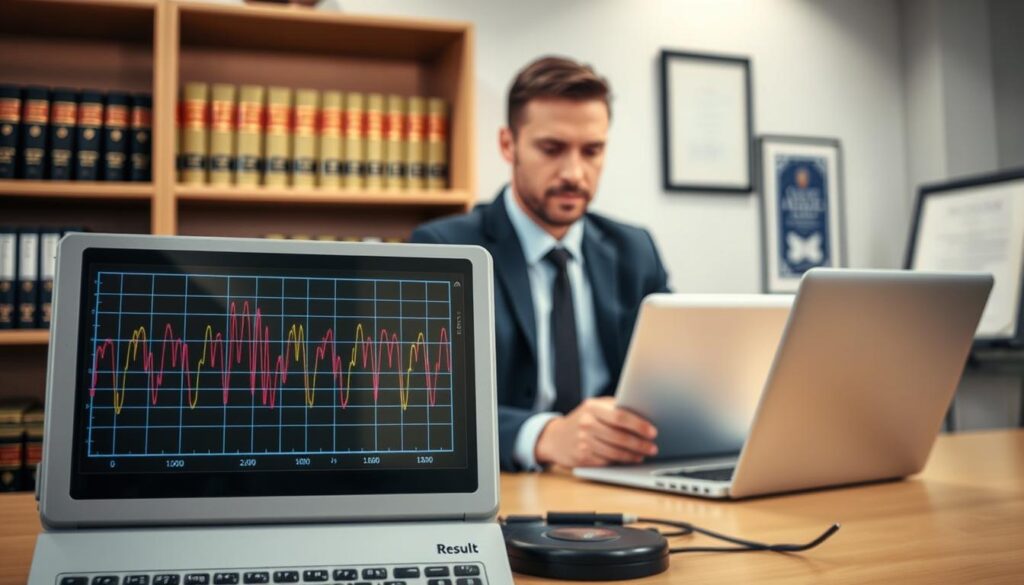
You’re holding a polygraph report. It looks official, with squiggly lines that supposedly show the truth. Let’s take a closer look.
Think of it as a Rorschach test, not a scientific readout. The data from your breathing, heart rate, and sweat is from the 1930s. The real magic happens before the test.
The examiner, a mix of psychologist and carnival barker, creates a “credibility imprint.” By the time you’re hooked up, the story is often set. The graphs are just an “approximation” analyzed “by eye and estimation alone.”
Reading these documents isn’t about finding lies. It’s about understanding the flawed, human theater of interpretation. We’ll show you where science ends and speculation starts.
False Positives/Negatives
Imagine a device that mistakes your anxiety for guilt and your calm for honesty—welcome to the polygraph. This isn’t a truth machine; it’s a stress interpreter with a terrifying margin for error. The result analysis from a polygraph is less a scientific verdict and more a Rorschach test administered by wires and sensors.
The industry’s official line, championed by groups like the American Polygraph Association, is one of stunning confidence. They claim accuracy rates between 85% and 95%. It sounds reassuring, like a high-grade medical test.
Independent researchers, on the other hand, paint a picture of deep uncertainty. Their studies suggest a real-world accuracy closer to 70%. The National Academy of Sciences has bluntly cautioned about the lack of rigorous scientific support for the polygraph. So, who’s right?
The data tells a clearer story when you line the claims up side-by-side. It reveals a gap wide enough to drive a truckload of ruined reputations through.
| Source | Claimed Accuracy | Context & Critique |
|---|---|---|
| American Polygraph Association | 85% – 95% | Based on ideal, controlled conditions and industry-funded studies. |
| Independent Meta-Studies | ~70% | Observed in real-world scenarios; notes high error rates in specific applications. |
| National Academy of Sciences | Not Scientifically Established | Finds “little basis for the expectation that a polygraph test could have extremely high accuracy.” |
Why does this discrepancy matter? Because in the realm of false positives and false negatives, the human cost is asymmetrical. A false positive means an innocent person is branded a liar. A false negative means a deceptive individual gets a free pass. The system is biased toward the first, catastrophic error.
Dr. David Raskin, a former polygraph supporter turned critic, calculated the grim math for screening tests. He found that in low-deception base rate populations, nine out of ten people flagged as deceptive would actually be telling the truth. You read that right. The machine’s “lie” is usually a mistake.
Further evidence from researchers like Dr. Douglas Carroll suggests that under certain conditions, up to 55% of innocent people could be found guilty by the polygraph. That’s worse than a coin flip. It’s institutionalized suspicion masquerading as science.
The fatal flaw is simple: the polygraph measures arousal—sweat, heart rate, breathing—not deception. Nervous about the test itself? Spike. Angry at the invasive question? Spike. A sociopath, a practiced liar, or someone simply medicated might show no physiological alarm bells. They skate through.
Your thoughtful result analysis, must start with a fundamental truth: the output is a measure of stress, not sin. Treating its readout as gospel is like using a weathervane to diagnose a heart condition. The needle moves, but it’s pointing at the storm in the room, not the secrets in your mind.
In the end, you’re not betting on a machine’s infallibility. You’re betting that your unique physiology won’t be misread as a confession. It’s a wager where the house—the testing industry—holds all the cards, and the deck is stacked with statistical ghosts.
When to Seek Legal Counsel
When a polygraph is mentioned, it’s time to call a lawyer. Imagine someone in power wants to check your truth with a machine. You might want to prove your innocence. That’s when you need a lawyer’s help.
The legal landscape is complex. The Employee Polygraph Protection Act (EPPA) of 1988 protects you in most jobs. But, there are exceptions for security, pharmaceutical, and government jobs. These loopholes are big enough to let a security van through.
State laws add more confusion. California is very skeptical of polygraphs, while Texas uses them in some cases. You’re dealing with fifty different rules, each with its own rules.

Court decisions don’t offer much comfort. Canada’s Supreme Court said polygraph evidence can’t be used in criminal trials. They found it unreliable. Most U.S. courts agree, allowing it only if both sides agree.
In family court or internal investigations, the rules get fuzzy. A judge might consider polygraph results. An employer could use them too. This is why you need a lawyer.
So, what does a lawyer do? They are your:
- Legal Translator: They explain the laws in simple terms
- Strategy Architect: They help you decide what to do about the test
- Rights Guardian: They make sure your rights are protected
- Response Designer: They help you make sense of the results
Getting a lawyer doesn’t mean you’re guilty. It means you’re smart and know your rights. Your lawyer will guide you through the complex laws.
At Polygraphianz, we study the mix of technology, psychology, and law. We know the best response to findings starts with knowing your rights. When a polygraph is involved, make sure you have legal advice, not just fear.
HR Communication Guidelines
Using a polygraph report in HR is like using a Magic 8-Ball for layoff decisions. It’s filled with flaws, making every talk a legal and ethical risk. Your communication plan must be solid.
Being open is your best defense. Explain the “why” clearly before any test. State how results will be used. This isn’t just good practice; it’s the law.
Groups like the B.C. Civil Liberties Association want a ban, citing science. They say it leads to “arbitrary persecution.” Polygraph results are more like bad horoscopes—subjective and unreliable.
So, what’s the right approach? Never rely on a polygraph alone. See it as one flawed piece in a bigger puzzle. Your official response should show this context. Use it as a tool, if you must.
Wrong use can lead to unhappy staff, costly lawsuits, and wrongly accused people. Focus on following the law and being ethical. Maybe the best move is to leave the polygraph in the past.