
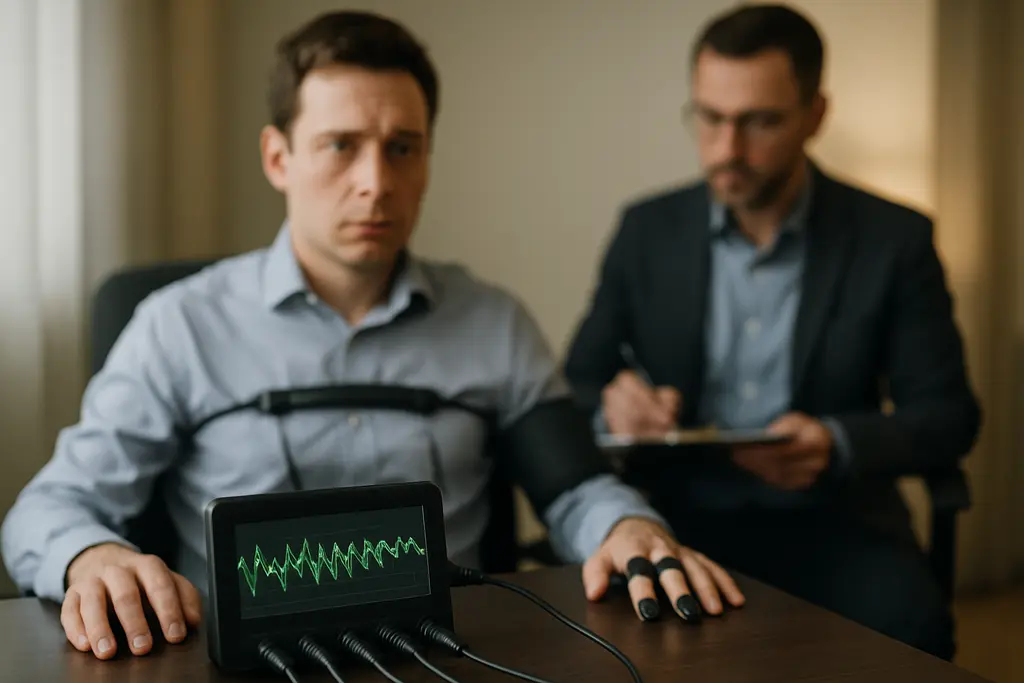
The Polygraph Examination Process is best understood as a structured information-gathering procedure, not a shortcut to certainty. In workplace settings, that distinction matters. A credible exam should be explained before it begins, limited to an appropriate purpose, documented with care, and interpreted alongside other evidence rather than treated as a stand-alone verdict.
Recent discussion around polygraph use has placed more attention on examiner qualifications, employee rights, and the risk of overclaiming what physiological data can prove. That is a useful shift for employers and examinees. The practical question is not whether a polygraph can settle every dispute. It is whether the process is lawful, transparent, relevant to the issue being examined, and handled in a way that protects workplace trust.
Polygraph Examination Process Basics
Polygraph Examination Process Phases
A legitimate exam is generally organized into three parts: a pre-test interview, the in-test recording of physiological responses, and a post-test review. The pre-test interview is not a formality. It gives the examiner time to confirm identity, discuss the issue under review, explain the equipment, review the questions, and assess whether the person appears able to participate in the exam as scheduled.
During the in-test phase, sensors commonly record respiration, electrodermal activity, cardiovascular activity, and movement or activity data. These readings do not measure truth directly. They record physiological changes that may be relevant to the examination format. That is why question wording, examiner training, and the scope of the issue matter. A vague question can produce data that looks significant while still being hard to interpret responsibly.
A sound Polygraph Examination Process begins before any sensors are attached. Examinees should understand the purpose of the test, the general question areas, the expected sequence, and what will happen with the results. For a step-by-step employee-oriented discussion, the related explanation of the polygraph process for employees may be useful background before an exam is scheduled.
What The Post-Test Review Should Clarify
The post-test stage should address what was recorded, what the examiner concluded, and whether any result was inconclusive or required further review. A cautious workplace should avoid treating a single result as the complete investigative record. Interviews, documents, access logs, inventory records, witness statements, and policy evidence may all remain relevant, depending on the matter under review.
This is also where clear communication reduces unnecessary harm. If the result is reported to management, the report should be limited to authorized recipients and should not include irrelevant personal detail. Clear communication standards matter across service environments, including related professional networks such as Finest Image, where trust depends on transparent processes and conscientious disclosure.
Legal Boundaries For Workplace Testing
Private Employer Limits Under EPPA
Workplace polygraph use in the United States is not simply an employer preference. The Employee Polygraph Protection Act of 1988 generally prohibits most private employers from using lie detector tests for pre-employment screening or during employment, with limited exceptions and procedural protections identified by the U.S. Department of Labor in its EPPA guidance. Employers should treat those limits as a compliance starting point, not an afterthought.
For employees, the Polygraph Examination Process should never feel like an unexplained demand. Where an exam is legally permitted, examinees should receive clear information about the reason for testing, the nature of the questions, their rights under the applicable framework, and how results will be handled. This article is educational and should not be read as legal advice; employers and employees facing a specific dispute should consult qualified counsel or the relevant enforcement agency.
Federal Examiner Standards As A Quality Signal
Federal standards show why examiner qualifications and workload limits matter. Department of Energy regulations require certified examiners, specialized training and investigative qualifications, approved formats, and a limit of no more than five polygraph examinations in a 24-hour period under the cited rule at 10 CFR § 709.31. Those requirements do not apply to every private workplace situation, but they illustrate a broader principle: the credibility of an exam depends partly on the standards governing the examiner and the format.
That point is practical rather than academic. An employer evaluating a provider should ask how examiners are trained, what formats are used, how questions are reviewed, how inconclusive outcomes are reported, and whether the provider separates testing from disciplinary decision-making. A provider that cannot explain those safeguards in plain language should not be treated as a low-risk choice.
How Recent Developments Change Expectations
Greater Scrutiny Of Screening And Broad Questions
Recent developments have reinforced a long-standing caution: broad screening questions are harder to interpret than narrowly framed, event-specific questions. A workplace investigation usually has a defined concern, such as a missing asset, an unauthorized disclosure, or a policy violation. The closer the exam stays to a defined issue, the easier it is to evaluate whether the test was relevant and fair.
By contrast, multiple-issue or loosely framed screening can blur the meaning of a response. An examinee may react because a question is confusing, embarrassing, too broad, or connected to an unrelated concern. That does not mean all responses are meaningless. It means the process should be designed to reduce avoidable ambiguity before charts are collected.
Technology Does Not Remove The Need For Judgment
Research interest in computerized scoring and alternative assessment methods has continued, but technology should not be used as a reason to make stronger claims than the evidence allows. Software can assist with consistency, but it cannot repair an unclear question, an unlawful purpose, poor consent practices, or weak investigative planning. Human judgment remains involved in deciding what to test, how to ask it, and how much weight to give the outcome.
Employers should be especially cautious about marketing language that implies certainty. A better provider will explain both value and limits. That includes acknowledging that polygraph results are one category of evidence, that inconclusive outcomes can occur, and that administrative decisions should be supported by a broader factual record.
Practical Preparation Without Overclaiming

What Examinees Can Reasonably Ask
Preparation should focus on understanding the process, not trying to manipulate it. An examinee can reasonably ask who requested the exam, what issue is being examined, what question areas will be covered, how long the appointment is expected to take, who will receive the report, and what policies apply to confidentiality. Those questions do not interfere with testing; they support informed participation.
Examinees should also raise legitimate concerns before the in-test phase begins. That may include confusion about a question, a language issue, a medical condition, fatigue, or uncertainty about the scope of the matter. The examiner should be able to address process questions without pressuring the person to accept unclear wording.
What Employers Should Document
Employers that are permitted to request an exam should document the business reason, the legal basis or exception being relied on, the notice provided, the provider selected, and the limits on result access. They should also document what other evidence exists. A polygraph should not be used to fill gaps created by a weak investigation.
- Define the issue before contacting a provider.
- Confirm that the exam is allowed under the applicable employment rules.
- Use narrowly framed, relevant question areas.
- Limit result access to people with a defined need to know.
- Evaluate the result with other evidence rather than in isolation.
These steps help protect both sides. Employees receive clearer expectations, and employers reduce the chance that the exam will be seen as arbitrary, retaliatory, or disconnected from the evidence.
Workplace Integrity And The Polygraph Examination Process
The Polygraph Examination Process is strongest when it is treated as a controlled procedure with legal boundaries and evidentiary limits. It can support a workplace integrity program in specific settings, but it should not replace policy design, supervision, access controls, documentation, and fair investigative practices.
A transparent process also helps protect morale. Employees are more likely to view testing as legitimate when they understand why it is being used, what rules apply, and what the result can and cannot prove. That does not guarantee agreement with the decision to test, but it creates a more defensible process than surprise, vague instructions, or exaggerated claims.
For organizations, the ethical standard is straightforward: use polygraph services only where allowed, explain the purpose clearly, rely on qualified examiners, keep questions relevant, protect sensitive information, and interpret results cautiously. That approach respects the limits of the tool while preserving its possible value in narrowly defined workplace matters.