

Let’s face a harsh truth. Studies show we lie about four times a day. We all tell little lies to get by.
We created the polygraph, or lie detector test, to find the truth. It aims to read our body’s reactions, not just our words.
The polygraph is said to be “scientifically reliable”. It looks at heart rate, blood pressure, breathing, and sweat to detect lies.
But, the question of its accuracy is complex. Supporters say it’s right 83% to 95% of the time. Yet, critics point out false positives can be over 50% in some studies.
So, is it a reliable tool or just a guess? This debate goes to the heart of what the polygraph is all about.
Scientific Foundation vs. Legal Standard
Imagine a scientific tool that can be affected by a simple prescription, yet is trusted to check who gets access to top secrets. Welcome to the world of the polygraph, where shaky science meets stubborn rules.
The machine doesn’t detect lies. It’s a tool that listens to your body’s hidden signals. It looks at heart rate, blood pressure, breathing, and sweat. These signs are controlled by your Autonomic Nervous System (ANS).
The idea is that lying makes you stressed, and stress makes your ANS react. But, the ANS is very tricky. A spike in blood pressure could mean guilt or a health issue. Lack of sweat might show honesty or a side effect of medication.
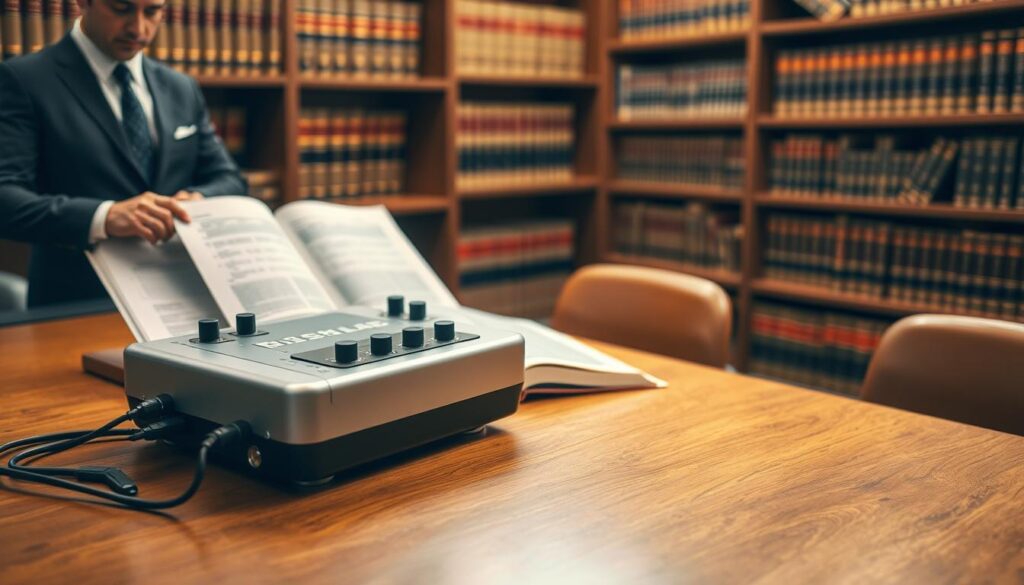
Given these challenges, how does the law view polygraph evidence? With a lot of doubt. The U.S. Supreme Court has set a high bar. Most courts follow this rule. They say inadmissibility is the rule. Polygraph results are seen as unreliable and can’t be used in court unless both sides agree.
This leaves us in a tricky situation. The science is shaky, and courts don’t trust it. But, there’s a law that makes an exception. The Employee Polygraph Protection Act (EPPA) of 1988 says private employers can’t use lie detectors. But, it makes an exception for government agencies, like in national security.
This law is a big contradiction. It says the polygraph is too unreliable for courts but good enough for national security. The message is clear: not good enough for a court, but good enough for secrets.
The table below shows this big contradiction:
| Perspective | Scientific View | General Legal View | Policy Exception (EPPA) |
|---|---|---|---|
| Core Principle | Measures physiological arousal (ANS activity) as a proxy for deception. | Evidence must be reliable and its prejudicial effect must not outweigh its probative value. | Bans use to protect employees from unreliable testing, with exemptions for government. |
| Major Flaw | ANS signals are influenced by medications, disorders, and plain anxiety—not just lying. | Polygraph results are seen as inherently prejudicial and scientifically questionable. | Creates a two-tier system: unreliable for commerce, but acceptable for state security. |
| Stance on Polygraph Evidence | Fundamentally skeptical of its diagnostic accuracy. | Generally inadmissible as evidence unless stipulated by all parties. | Deems it inappropriate for most employment, yet sanctions its use in high-stakes government screening. |
This isn’t just a debate about admissibility. It’s about how laws can ignore science when it’s inconvenient. We reject a tool in one area but use it in another when it’s useful. The polygraph’s journey shows how we pick and choose what we believe based on power.
Acceptability in Court/Workplace
Employers thinking about using polygraphs to find the truth face many legal hurdles. They must deal with laws against privacy and the risk of false positives.
In the U.S., the Employee Polygraph Protection Act (EPPA) of 1988 blocks most use. It only allows exceptions for certain security or theft investigations. So, most corporate HR departments can’t use them.
Going to Canada, the rules change. Each province has its own rules, making it confusing. It’s like a traffic light system.
| Jurisdiction Type | Key Examples | The Legal Reality |
|---|---|---|
| Red-Light | Ontario, New Brunswick | Outright ban. The law says you simply cannot require an employee or candidate to take a polygraph test. |
| Yellow-Light | Federal, Alberta, BC, Québec | No specific ban, but use is heavily restricted by privacy legislation. “Voluntary” consent is scrutinized, often making it a legal fiction when a job is at stake. |
| Greenish-Yellow | Other provinces (e.g., based on common law) | No explicit statute says “no,” but employers risk violating common-law privacy rights. The tort of “intrusion upon seclusion” from cases like Jones v. Tsige creates a massive litigation risk. |
The issue of “voluntary consent” is a legal trap. In employment, saying “yes” might not be truly voluntary. Courts often see this as a violation of privacy.
Why are employers so cautious? The main reason is the risk of false positives. A person on medication might get a false reading. This can ruin a career.

Such mistakes can destroy trust and careers. They are not just about wrongful dismissal. They also involve defamation and emotional distress.
Studies show polygraph errors are common. For example, the Journal of the American Academy of Psychiatry has highlighted these issues. These errors can change lives.
So, can you use polygraphs at work? The answer is a big “It’s a profound gamble.” Even where laws allow it, the risks are too high. It’s a gamble with careers and trust in the workplace.
Impact on Employee Relations
Requiring a polygraph during a theft investigation is more than a policy. It’s a psychological event. It sends a clear message: your word is not enough. We need to watch your sweat glands.
This act turns a professional relationship into something from a dystopian HR manual. The foundation of any good workplace—mutual trust—is lost. It’s replaced by suspicion.
The workplace polygraph testing might follow the law, but the cost is huge. You get short-term suspicion but long-term resentment.
Creating a truthful workplace doesn’t need a truth serum. It needs transparency and fair processes. Focus on clear policies, not polygraph charts. A culture of open communication is the best lie detector. It builds trust without destroying it.